
“The superbly handsome Model 77 will delight you with its performance and excellent handling qualities,” the Winchester owner’s manual reads. “Featuring the best materials and workmanship, both Model 77 rifles are rugged and dependable, with accuracy fully up to Winchester standards.” A more concise and realistic pitch would have been, “Quality, with quirks.”
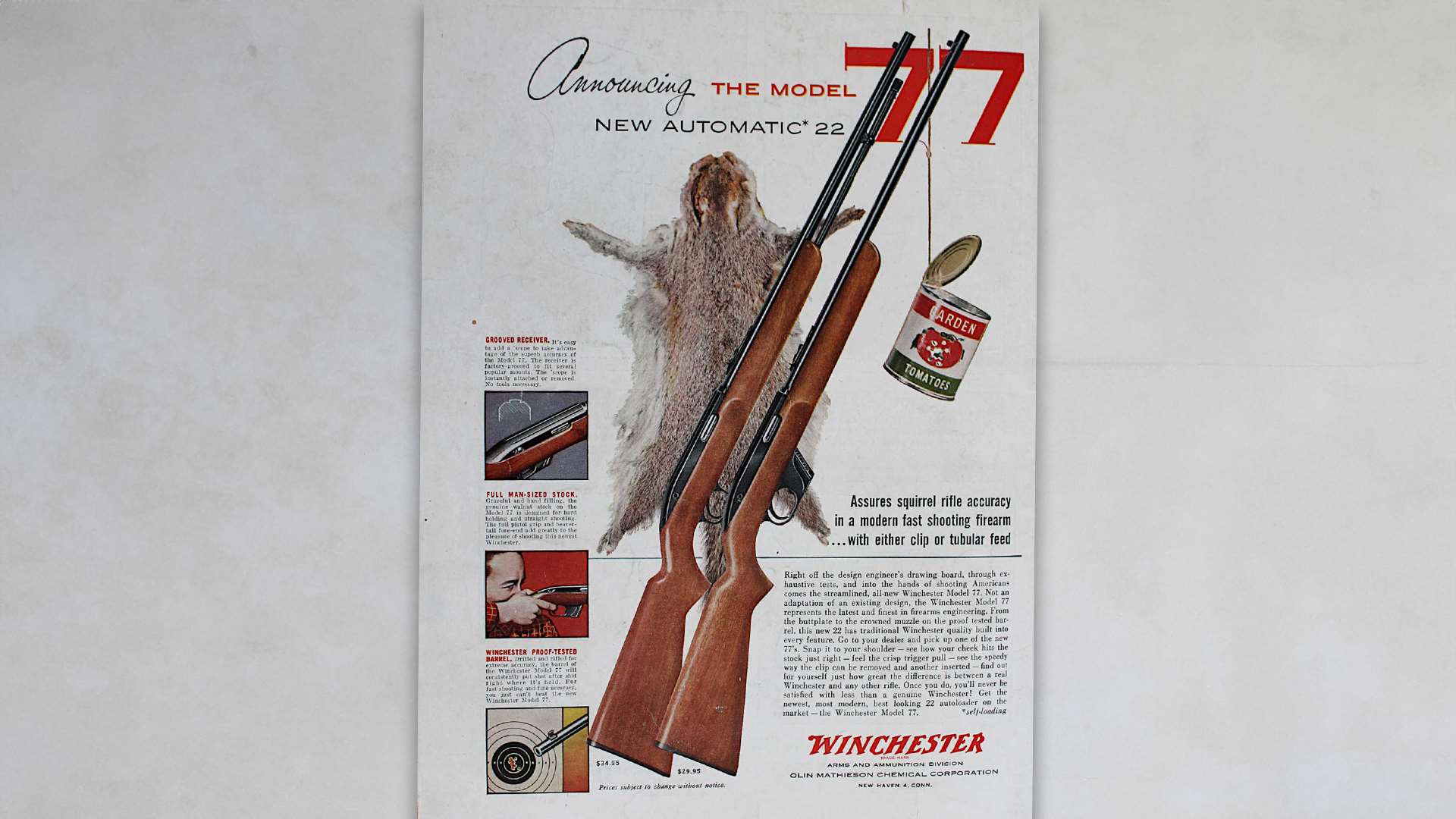
Winchester introduced the Model 77 chambered in .22 Long Rifle in 1955, with the retail price of the eight-round detachable-magazine rifle at $29.95 (equating to $343 today) and the 15-round tubular magazine version available for another five bucks. By 1961, the price had risen to $46.95 ($537 in 2024 dollars) with, again, a tubular magazine adding another sawbuck. Two years later, Winchester discontinued the Model 77 after producing about 217,000 rifles.
Though it at first undersold semi-automatics from competitors like Mossberg, Remington, Savage and Marlin, the Model 77’s rapid and significant price increase is one reason why Winchester discontinued the rifle: quality manufacture in competition with other brands became impossible when Winchester was forced to pinch pennies. Winchester also pinched on its venerable pre-1964 Models 70 and 94, as all riflemen know, but they soldiered on via cutting back on quality and features.
M1 Carbine DNA
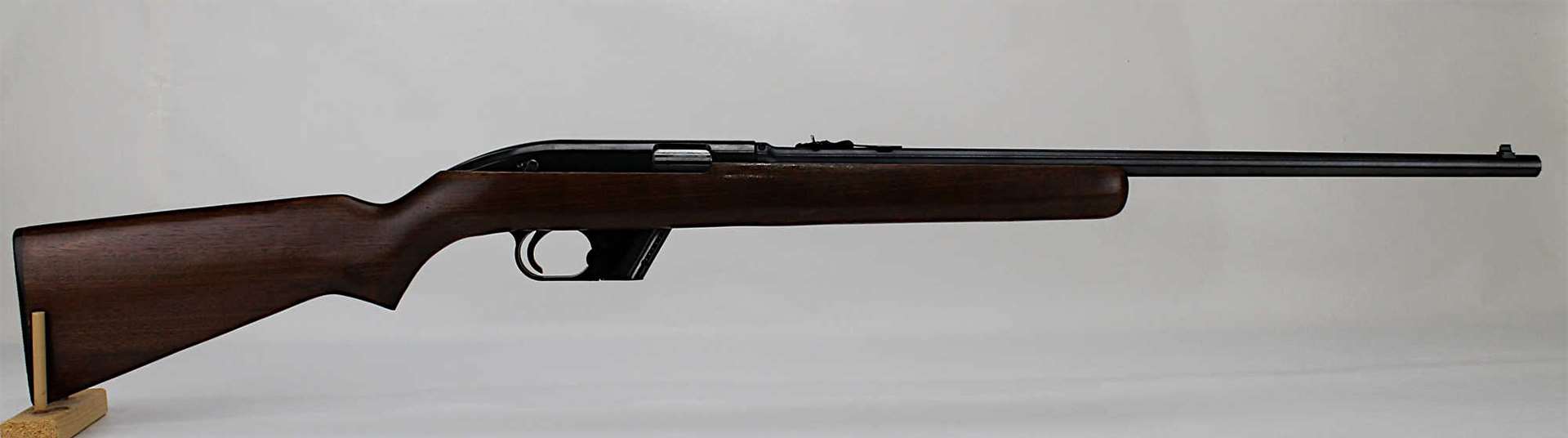
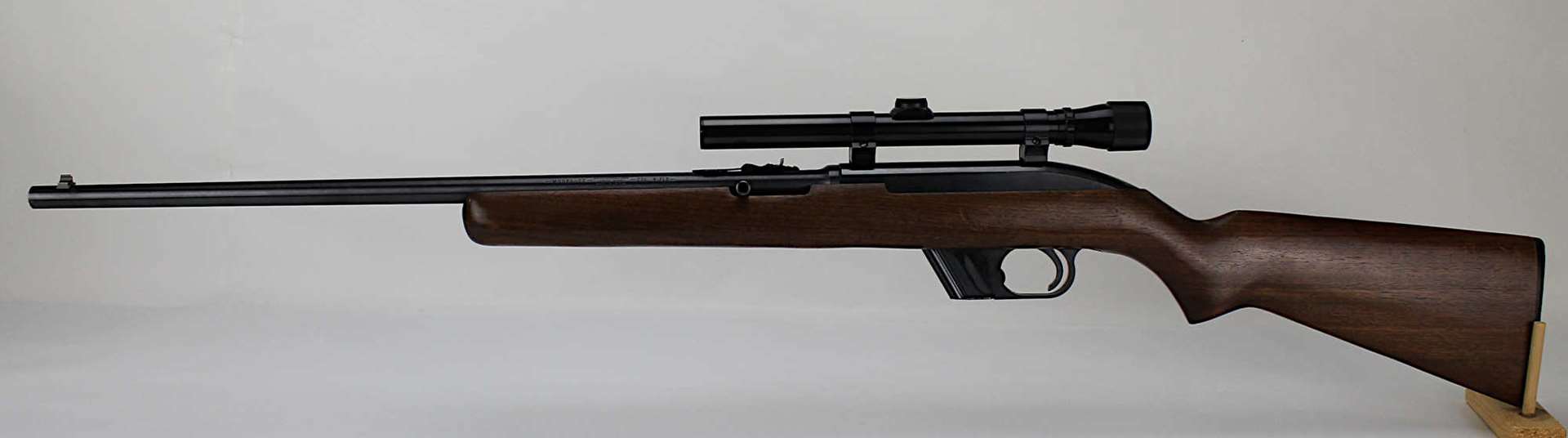
Model 77s did not suffer the Model 70’s post-64 ignominy, and unlike so many other semi-automatic rimfire guns, the rifle presented here exudes an uncommon aura of quality. Some minor handling dings in the wood, a tiny scratch where the safety lever rubs the receiver and a few miniscule mystery holes in the plastic butt plate reduce this specimen from “minty” to NRA Excellent condition. Happily, there are no buggered screw slots from amateurish maintenance and the bluing is still like-new.
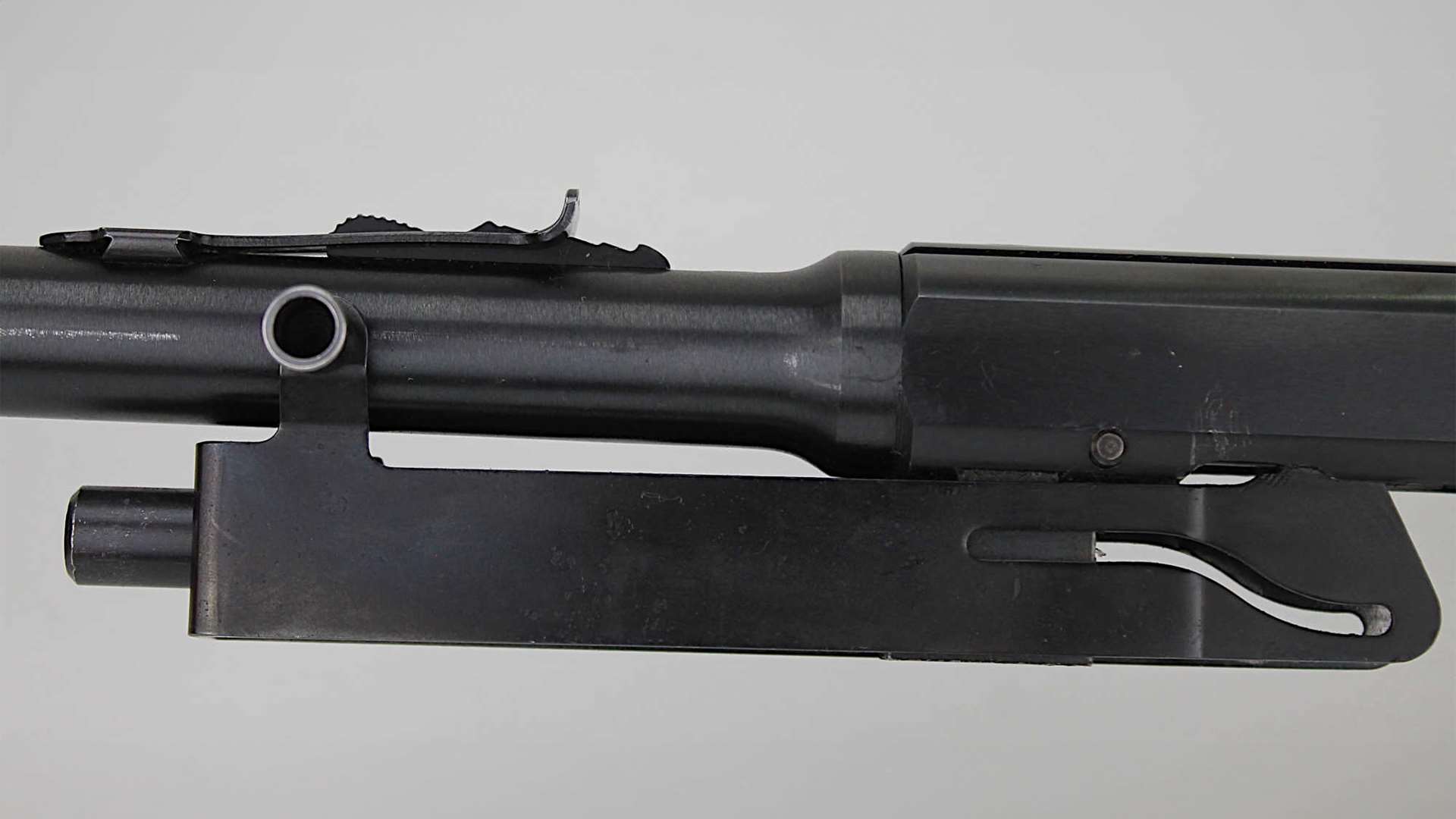
The first feature of the Winchester Model 77 to jump out at the handler is the “tactical” style charging handle on the left side of the barrel just forward of the receiver. The charging handle attaches to an operating slide assembly, in turn attached to the bolt. A recoil spring on a stout guide rod sends the handle, operating slide assembly and bolt forward into battery. The system shows a bit of DNA from the World War II M1 Carbine, which was also developed by Winchester. The streamlined receiver is entirely closed save for the ejection port; the only projection interrupting the smooth lines is the small safety lever on the right side. In addition, the receiver top is grooved for tip-off/claw mount rings.
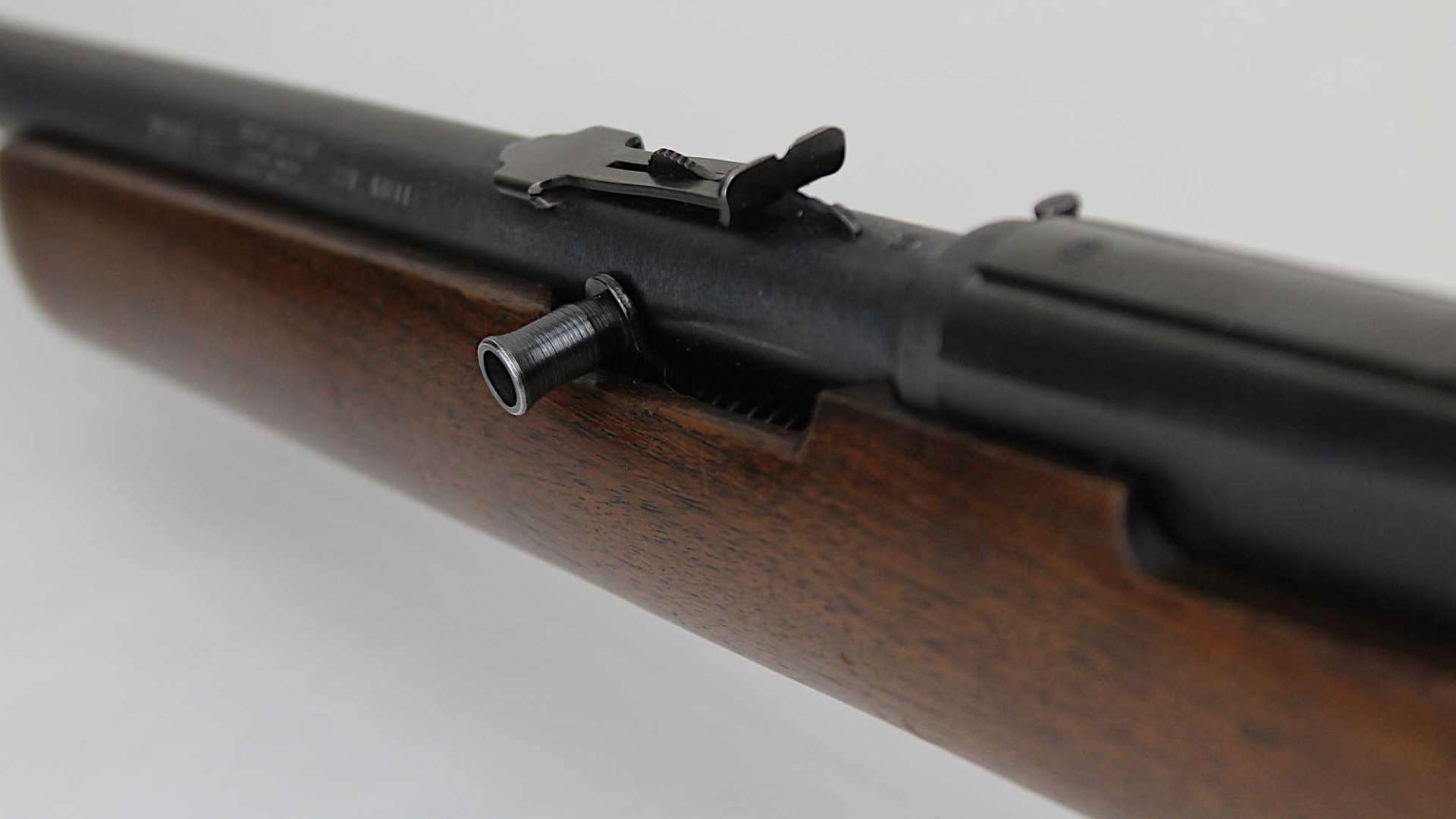
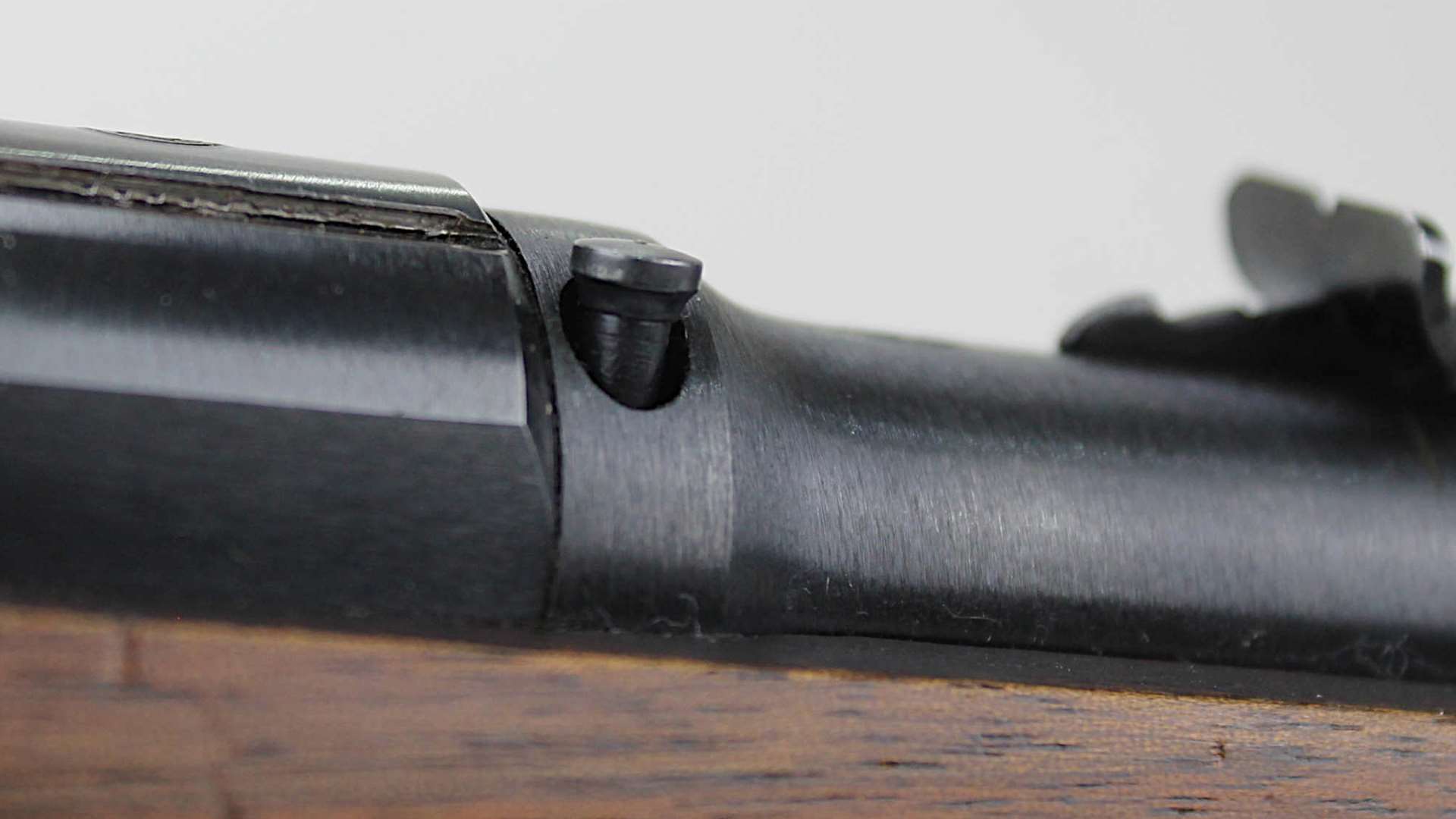
This specimen has a second unusual feature, the “bolt hold-open button” on the barrel’s right side just in front of the receiver, which appears only on Model 77s made at the end of production from 1960 to 1963. Retracting the bolt and pushing the pin downwards holds the bolt open when the pin engages a notch in the operating slide assembly. Pulling back slightly on the charging handle while raising the pin with your fingernail releases the bolt to go forward into battery. Obviously then, the bolt does not lock open after firing the last round.
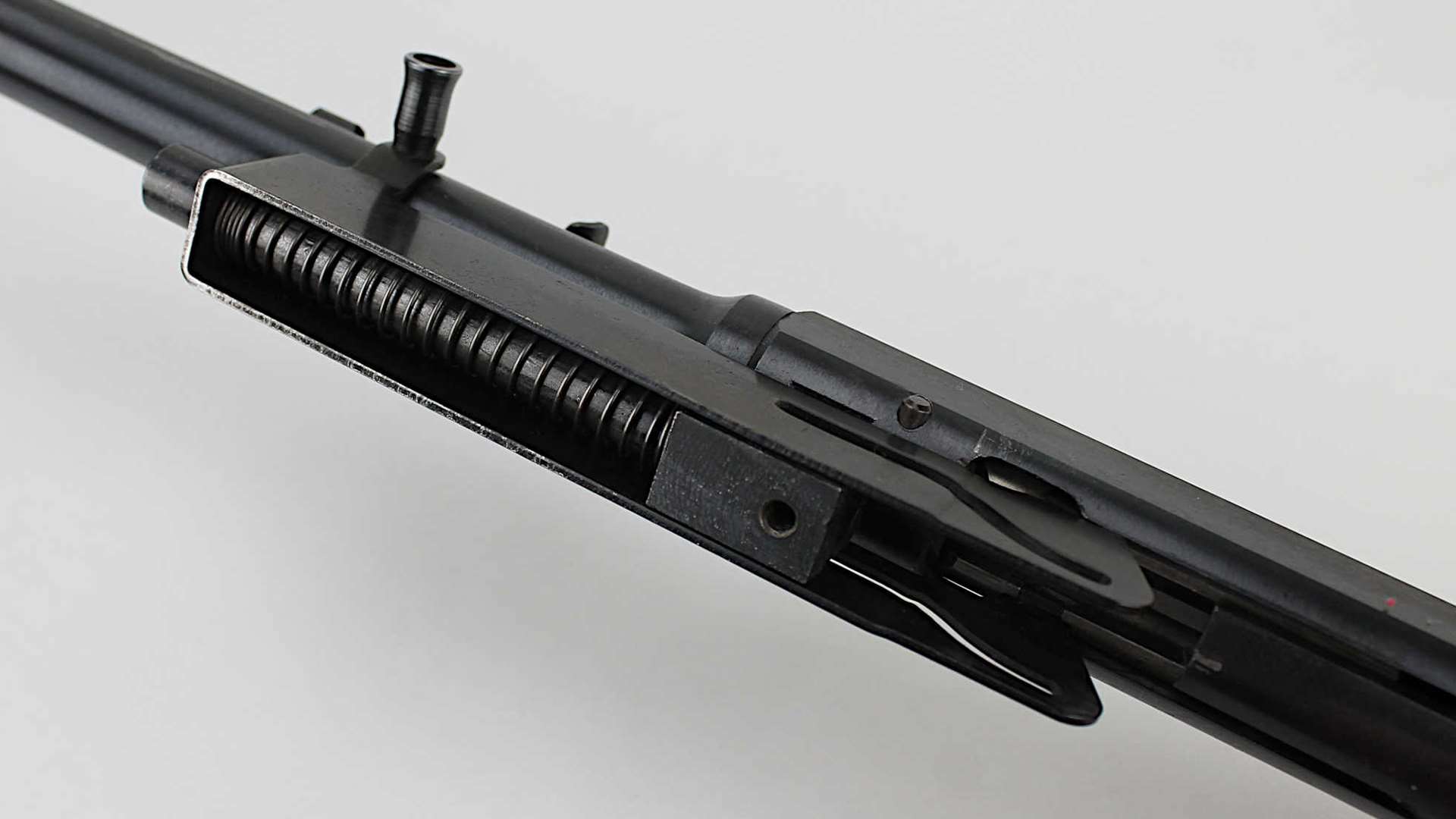
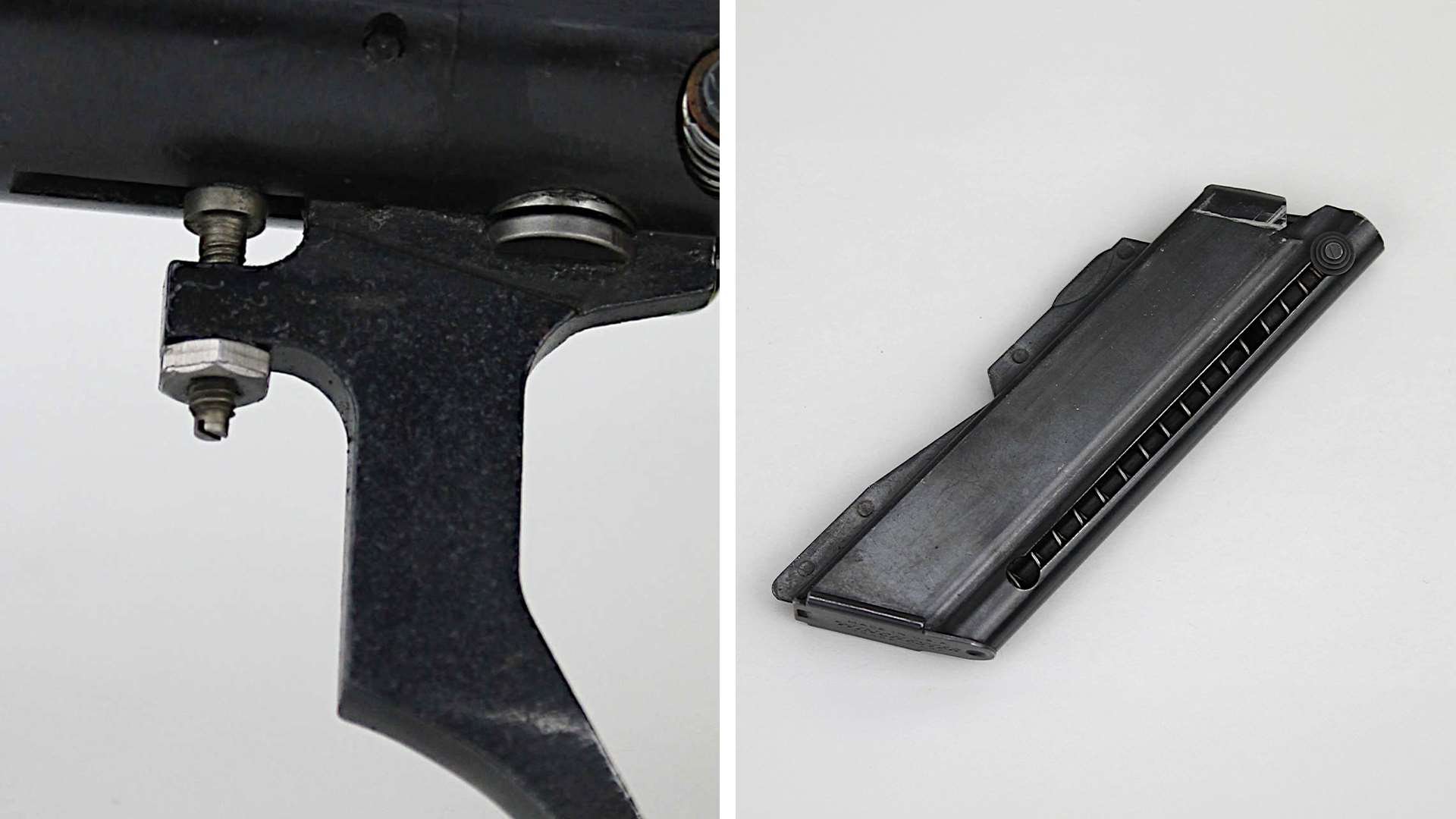
Another attention-getter is the magazine configuration. The eight-round detachable magazine mounts onto a slide incorporated into the front of the trigger guard, its forward angle presenting a rakish appearance perhaps deliberately reminiscent of a period jet aircraft. The magazine release is inside the trigger guard, at the front. Doubtless a cost-savings measure for Winchester, the entire trigger guard is plastic.
There is a further unusual feature for semi-automatic .22s found on the Winchester Model 77—an adjustable trigger, a simple screw with a locknut that adjusts sear engagement. The stock must be removed to access the trigger adjustment.
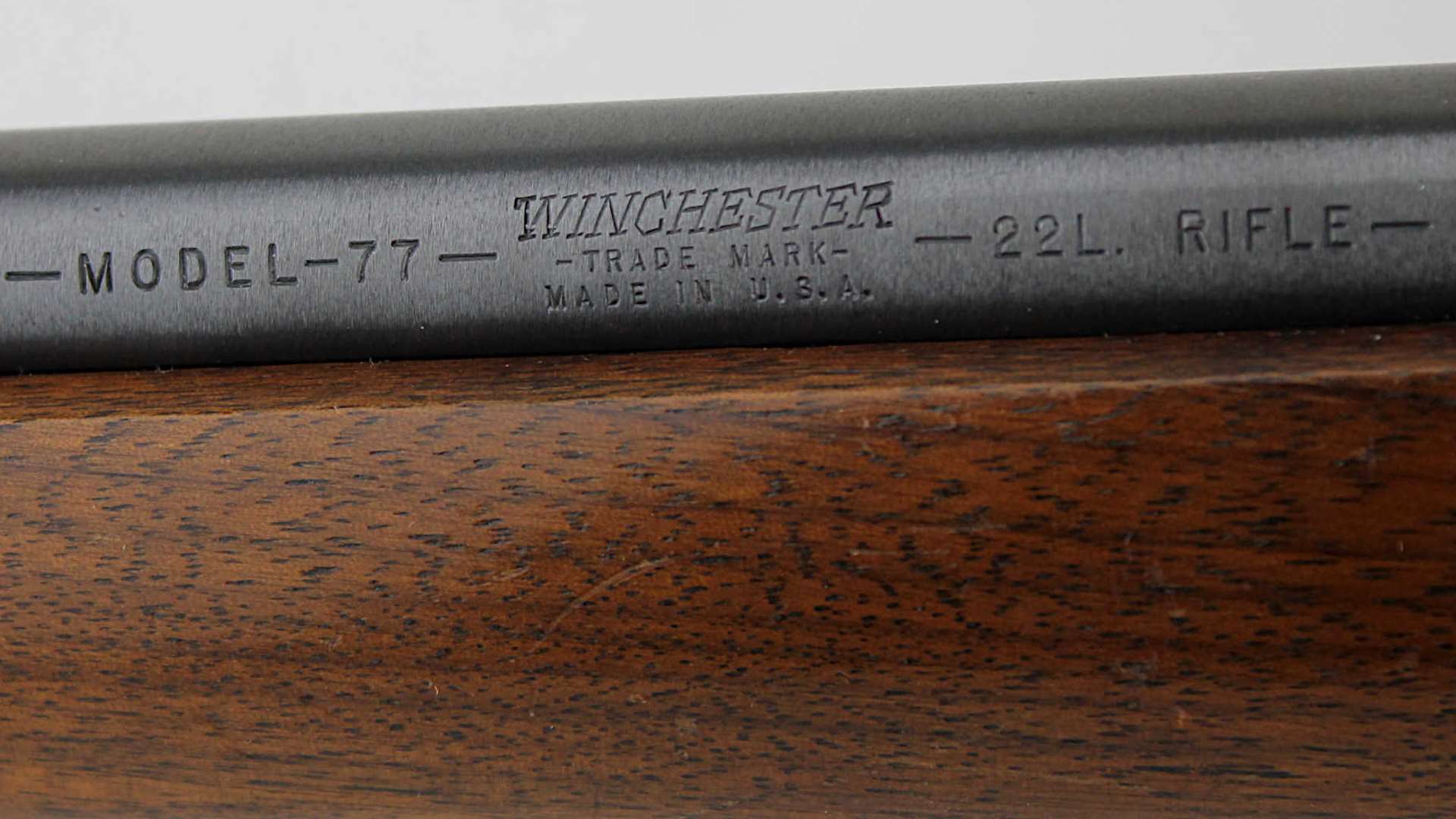
Weighing only about 5½ pounds, this is nonetheless an adult rifle with a 22-inch barrel, 13½-inch length of pull and an overall length of 40 inches. Sights are typical of Winchester sporting .22s, a brass-beaded blade front sight dovetailed into the barrel and a V-notch rear sight with a sliding elevator. Being a pre-Gun Control Act of 1968 firearm, this rifle bears no serial number, though some Model 77s are serial-numbered (beginning with 1001). The only markings are the barrel stamps, “MODEL 77” and “22L. RIFLE” flanking “WINCHESTER TRADE MARK MADE IN U.S.A.” By this point in manufacture, Winchester switched from walnut to less expensive birch for the stock. Even so, this one shows some fair, if rather straight grain. Fore-end is semi-beavertail.
Peevish and Recalcitrant
Winchester Model 77s possess some proclivity for peevishness. The owner’s manual includes a troubleshooting guide that lists nine suggestions to resolve feeding issues, and eight more for ejection problems. There’s more on out-of-battery firing, a binding action, and the bolt riding over cartridges or failing to fully close.
Though the owner’s manual states the rifle can digest both standard velocity and high velocity ammunition, shooting cartridges of standard velocity or with bullet weights below 40 grains in the Model 77 may lead to jamming or stovepiping. Indeed, a May 1955 American Rifleman “Dope Bag” report on the then-new Model 77 mentioned such jamming during evaluation. Shooters may experience fewer such problems by using high velocity 40-grain bullet cartridges such as Federal American Eagle, or CCI Velocitor or Mini-Mag ammunition.
It also helps greatly to clean a dirty semi-automatic action. However, that 1955 Dope Bag evaluation found complete disassembly of the Model 77 “inadvisable,” that reassembly required the “development of some skill and the expenditure of some fingernails,” and opined that few owners would “disassemble it for cleaning more than once”—such recalcitrance perhaps being a second reason for its short production run.
Parts for the Model 77 are available from Numrich Gun Parts Corp. and other parts houses. Reproduction detachable magazines made by Triple K can be had for $40 to $55; eBay sellers want $80 to $100 for original Winchester detachable magazines.
Despite the Winchester name, the Model 77 garners only tepid interest from collectors. A book I have on the history of Winchester firearms doesn’t even mention the Model 77, nor does a guidebook on Winchester rifle values. The most recent edition of the “Blue Book of Gun Values” suggests a $350 value for Model 77s in 95 percent condition. An online search showed internet auction asking prices of Model 77s reaching $599, but actual selling prices spanning $165 to $400. Compare that to the 2024-dollar price in 1956 and 1961, and we see today’s values mirroring original prices.