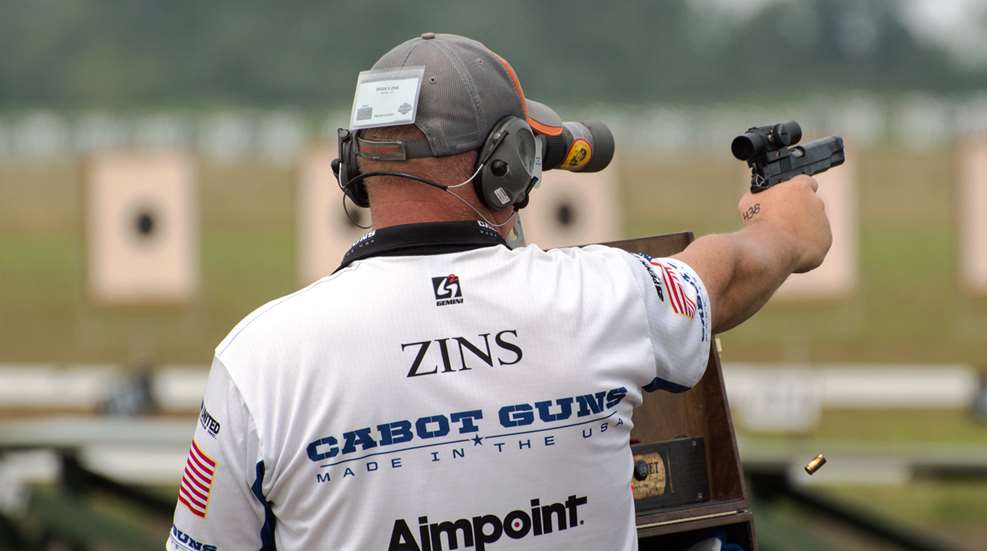
 Twelve-time NRA National Pistol Champion Brian Zins knows a thing or two about NRA Precision/Bullseye (Precision is the new official name for Bullseye) pistol competition. Brian’s thoughts on competition and technique are especially valuable, because he doesn't always follow the old traditions with his technique. In this article, he shares his thoughts on trigger control.
Trigger Finger Placement
There is only one part that really, really counts when the shot breaks. Now don’t get me wrong, stance, grip and aiming are important but keep in mind that you can have a perfect grip and hold perfect sight alignment all day long. It only counts when the gun goes bang and only one action causes the gun to do that pulling the trigger. You can hold the gun upside down, squeeze the trigger with your pinky, and align the sights to the target in a mirror and shoot tens as long as you don’t jerk the trigger.
However, please DO NOT try that at home!
Aside from that, this is what I was taught and this is what I do. And just keep in mind it is only one way, and not the only way but I have had pretty good results with it. Also, this is for a trigger with at least a little roll, which is my preference.
First let’s look at trigger finger placement. And remember this is an article on Bullseye shooting. If this were an article on free pistol or air pistol, it would be different. So, international shooters please don’t unleash the hounds on me.
Now, where should the trigger make contact on the finger? The trigger should be centered in the first crease of the trigger finger. Why you ask? We have always been taught to place the pad on the trigger. If you have a trigger that weighs in-between two and four lbs., that is enough weight to move the fleshy part of the pad of your finger. Try it! Get something that weighs at least two lbs. and has a tip or point on it the size of a pen, or just use a trigger. Put your hand on a table or desk, palm up and slowly lower the weight onto the pad of the finger. It moves a lot. Now lower the weight onto the first crease of the finger, right on the joint. Sure it moves, but a whole lot less than the fatty, fleshy part of the pad of the finger.
Now having conducted this little experiment, think about pulling the trigger with the pad of the finger. The first part of movement you feel is flesh and fat moving out of the way. This is not part of the movement involved in trigger control.
For example, have you ever been shooting well and in slow fire you start to get “chicken finger?” The trigger starts moving and then it stops and feels like it weighs 30 lbs., or did it move at all? Maybe what you felt was the flesh moving out of the way because you were shooting well and didn’t want to screw up the match, so you are really in tune with what you are feeling in the trigger.
Now think if the trigger were placed at the crease or first joint of the trigger finger. When the trigger moves, what you are feeling is really the trigger moving.
Let’s go even deeper.
Take a pen or a pencil and start tapping the fleshy part of the web between your trigger finger and the thumb. Keeping the same intensity, move the tapping up to the large knuckle on your trigger finger. Feel the difference? The flesh acts as a shock absorber to the tapping where the tendon in the joint is more of a conductor. I know what you’re thinking. Why do I want to feel that?
Because it is that important to be able to feel every little movement of your trigger so you know that you are squeezing the trigger and not jerking the trigger.
Types of Trigger Squeeze
I remember when I was in Boot Camp, and they taught us about trigger control before we went to the rifle range. I now look back and realize they were, well not wrong, but mistaken (just in case I run into my old Drill Instructors and by some strange twist of fate they read this article). The Marine Corps taught two different types of trigger control: Interrupted and Uninterrupted. And I still believe that there are two types: Uninterrupted and Wrong.
If trigger control is ever interrupted in slow fire, the shot needs to be aborted and the shot started over. If trigger control is interrupted in a sustained fire stage, then we revert to our “key word” that triggers us to kick start our shot process.
The Relationship Between Sight Alignment and Trigger Control
Often when the fundamentals are explained, these two are explained as two different acts. Well truth be told, it’s really kind of hard to accomplish one without the other. They have a symbiotic relationship. In order to truly settle the movement in the dot or sights you need a smooth, steady trigger squeeze. Trigger control is merely a reaction to what the eye sees.
What? One can hold perfect sight alignment/sight picture for a long time. Now, apply pressure to the trigger and what happens? Something moves right? If this happens in a slow fire shot what typically happens? We stop squeezing until everything settles down again and we start the trigger. It moves. We stop the trigger. It settles. We start the trigger. It moves and so on and so on. So from this we can see how the finger already acts to what the eye sees. We do not have to train the eye to accomplish this, since it already does it. We need to make it work for us and get the finger to react at a more opportune time, before we have obtained perfect sight alignment/sight picture. Yes, I just said to start squeezing the trigger before you have obtained a perfect sight alignment/sight picture.
Your sight alignment should be pretty close to perfect, since we have mastered a perfect grip and the sights are aligned, not just to each other but also to the other eye as soon as the gun is raised. If not, we will master that soon. Before the sights or dot have settled into the center of the target, we should start our trigger squeeze, taking advantage of the pressure that is being applied to the trigger to help stabilize the sight. Continue to squeeze the trigger uninterrupted, using that pressure to help move toward and stay center and allow the shot to break.
Therefore as it stands, I am not a big believer in the surprise break. I know when my gun is going to shoot and I know what it feels like right up until it shoots. I really know my trigger and I have done lots of dry firing without looking at the sights, just to know what it feels like.
This method has been called steering the sights with the trigger, but I don’t like the connotation that carries. Therefore, it is more of a sight alignment/sight picture through trigger control concept.
For more tips from Brian Zins, or if you are interested in his training classes, please visit his web site: www.brianzins.com.