** When you buy products through the links on our site, we may earn a commission that supports NRA's mission to protect, preserve and defend the Second Amendment. **
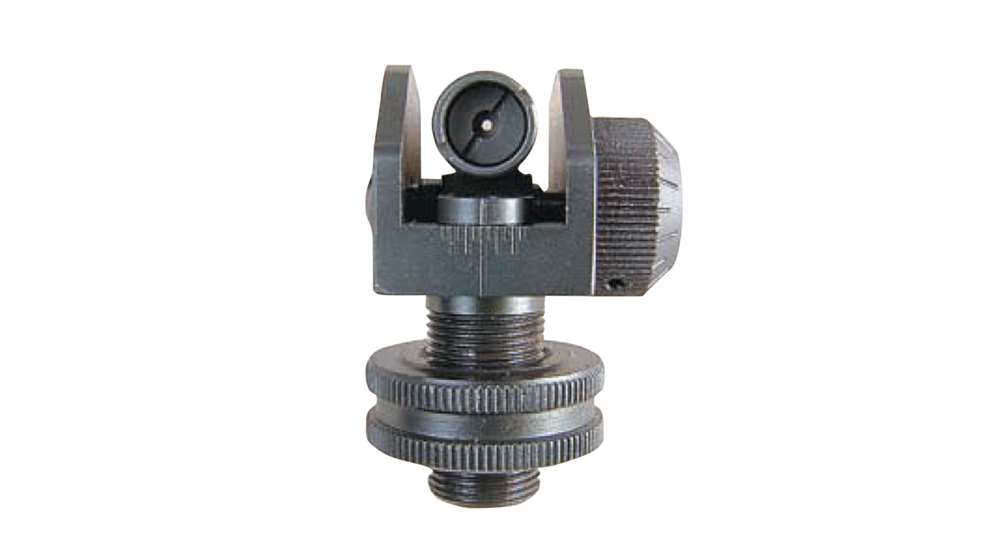
Above: A typical rear rifle sight aperture where a corrective lens insert can be mounted.
For several rifle disciplines, NRA Rule 3.7 allows adding a corrective lens to an iron sight. In this article, Dr. Norman Wong answers your questions concerning how to select such a lens and if one would be compatible with prescription glasses.
For the casual as well as competitive rifle shooter, vision becomes a challenge as we age. Rear sight lens inserts have been available for rifles such as the AR15, but shooters may have questions concerning what lens power is needed.
We go to the optometrist or the ophthalmologist to obtain our best possible vision. With perfect eyesight, a rear sight lens would typically not be needed because our prescription shooting glasses would allow us to see the sight picture clearly. For this reason, most shooters prefer dedicated shooting glasses.
As we age, the required eyeglass prescription may change so that plus or minus lens inserts may be of some temporary value until our shooting glasses are updated. However, without a new eye exam, we face the problem of not knowing which direction our eyes have changed: increased or decreased myopia (nearsighted), increased or decreased hyperopia (farsighted) or astigmatism (cornea not perfectly spherical).
Although looking through an aperture will enhance clarity in general, too much minus power would make the target appear smaller. Conversely, too much plus power would make the target appear too blurred. There exist a significant number of individuals who are in denial that they do, in fact, need eyeglasses. For whatever reasons, they refuse to get and wear corrective eyewear. Lens inserts may be of value for these shooters but it would be a trial and error determination of the needed power.
 For those who know what their prescriptions are but would rather not wear shooting glasses, here is a hint for those with astigmatism. We need to convert your Rx into the “Spherical Equivalent.” The numbers on your prescription represent Sphere/Cylinder/Axis. The cylindrical power is divided by two, and then added to the spherical power to obtain the resultant spherical equivalent. (The axis number is not used.) For example, a mildly nearsighted Rx of -0.50 - 0.50 x 180 converts to a spherical equivalent of -0.75 diopter for the lens insert. Another example for a mildly farsighted Rx of +1.00 – 0.50 x 180 would convert to a spherical equivalent of +0.75 diopter.
Those shooters who are unable to focus sharply on nearby objects (presbyopic) may not see their front sight posts clearly all the time. Even younger shooters who cannot maintain focus on the front sight post will benefit from plus power, either incorporated into their shooting glasses or as a lens insert. How much plus is needed would depend upon age and any fatigue factor at the range. While looking through the rear sight aperture, the plus power should not blur the target very much, if at all.
To focus on the front sight post of an AR15, we need about 1.75 diopters of accommodation. With the aid of an aperture-style rear sight, we actually need less. Diopter is an incremental measurement of how close we can focus: the higher the number, the closer the focusing ability.
For comparison sake, we have 7 diopters of accommodation available at age 30, only 4.5 diopters available at age 40, 2.5 diopters at age 50, 1.00 diopter at age 60 and only 0.25 diopter by age 70. A trip to the eye care specialist will hopefully help iron out all the details.
Read Dr. Norman Wong's previous article "Vertex Distance, Optimum Vision or Not?"
For several rifle disciplines, NRA Rule 3.7 allows adding a corrective lens to an iron sight. In this article, Dr. Norman Wong answers your questions concerning how to select such a lens and if one would be compatible with prescription glasses.
For the casual as well as competitive rifle shooter, vision becomes a challenge as we age. Rear sight lens inserts have been available for rifles such as the AR15, but shooters may have questions concerning what lens power is needed.
We go to the optometrist or the ophthalmologist to obtain our best possible vision. With perfect eyesight, a rear sight lens would typically not be needed because our prescription shooting glasses would allow us to see the sight picture clearly. For this reason, most shooters prefer dedicated shooting glasses.
As we age, the required eyeglass prescription may change so that plus or minus lens inserts may be of some temporary value until our shooting glasses are updated. However, without a new eye exam, we face the problem of not knowing which direction our eyes have changed: increased or decreased myopia (nearsighted), increased or decreased hyperopia (farsighted) or astigmatism (cornea not perfectly spherical).
Although looking through an aperture will enhance clarity in general, too much minus power would make the target appear smaller. Conversely, too much plus power would make the target appear too blurred. There exist a significant number of individuals who are in denial that they do, in fact, need eyeglasses. For whatever reasons, they refuse to get and wear corrective eyewear. Lens inserts may be of value for these shooters but it would be a trial and error determination of the needed power.
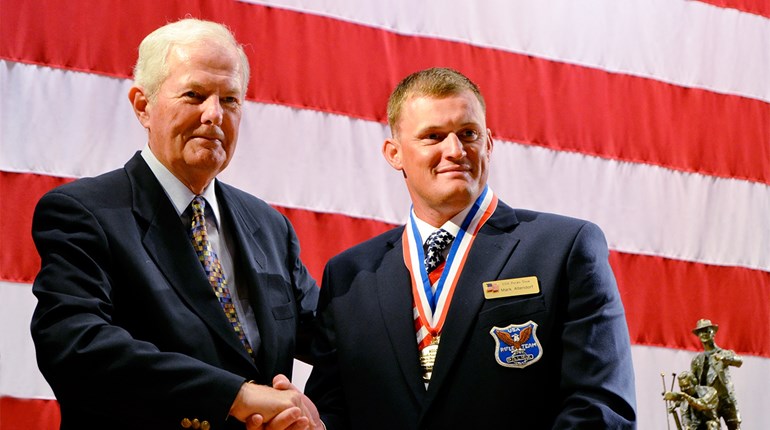
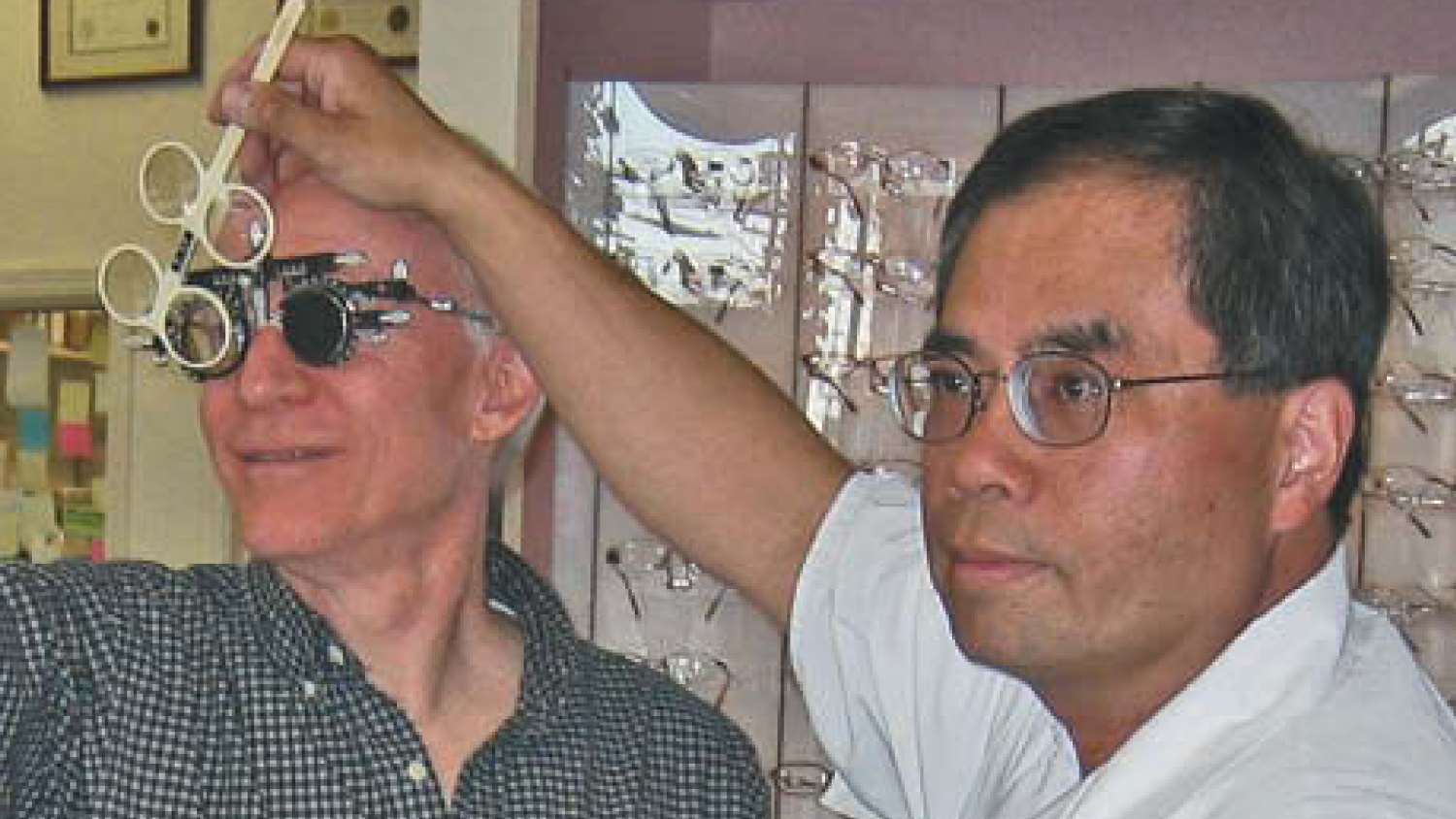
Dr. Norman Wong (r.) is a master bullseye shooter, optometrist and past contributor to Shooting Sports USA.
Those shooters who are unable to focus sharply on nearby objects (presbyopic) may not see their front sight posts clearly all the time. Even younger shooters who cannot maintain focus on the front sight post will benefit from plus power, either incorporated into their shooting glasses or as a lens insert. How much plus is needed would depend upon age and any fatigue factor at the range. While looking through the rear sight aperture, the plus power should not blur the target very much, if at all.
To focus on the front sight post of an AR15, we need about 1.75 diopters of accommodation. With the aid of an aperture-style rear sight, we actually need less. Diopter is an incremental measurement of how close we can focus: the higher the number, the closer the focusing ability.
For comparison sake, we have 7 diopters of accommodation available at age 30, only 4.5 diopters available at age 40, 2.5 diopters at age 50, 1.00 diopter at age 60 and only 0.25 diopter by age 70. A trip to the eye care specialist will hopefully help iron out all the details.
Read Dr. Norman Wong's previous article "Vertex Distance, Optimum Vision or Not?"