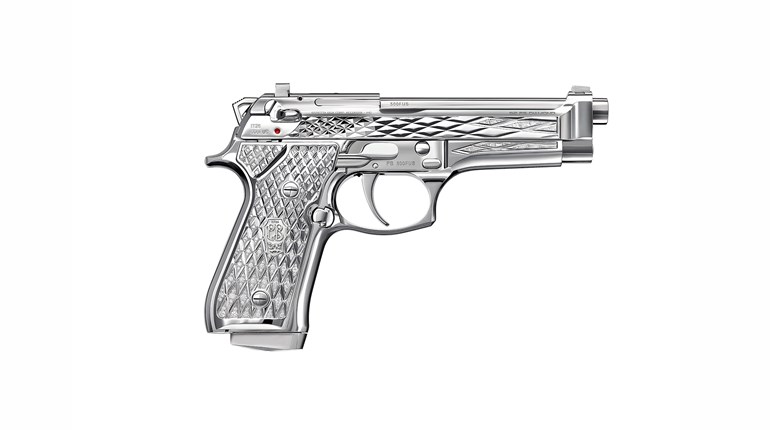

The great majority of pistols that will be purchased for hunting, plinking, self-defense or target work will be of conventional revolver or semi-automatic pistol design. Revolver actions can be further subdivided into single-action and double-action types, while semi-automatic pistols are offered in different design actions, including single-action, traditional double-action and double-action-only.
For some hunting or target activities, pistols of other action types may be preferred. Break-action pistols consist of a frame that houses the action parts, and a barrel or barrels attached to the frame by way of a hinge pin or pivot pin. This design allows the action to be opened for loading or unloading by pivoting the barrel downwards or, less frequently, to the side. Most such guns have a manually-cocked external hammer. Because of their strength and accuracy, some break-action pistols are chambered for rifle cartridges and often have barrels 14 inches or longer.
A special category of the break-action pistol is the derringer, well-known to viewers of Western movies and TV shows. This is a light, small, short-barreled arm with one or two barrels, an external manual hammer and a latch that releases the barrel to be pivoted downward or to the side. Derringers typically are chambered for pistol rounds.
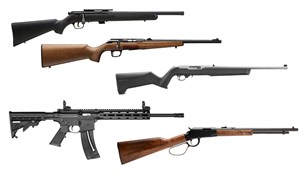
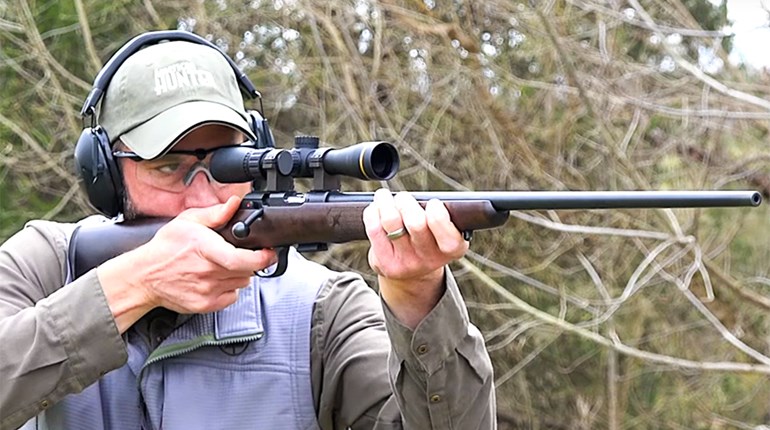
Bolt-action pistols function in the same manner as bolt-action rifles. The receiver is usually tubular, with the barrel attached at its forward end. Inside the receiver is a bolt with protruding locking lugs that engage lug seats in the receiver. Turning the bolt both cocks the spring-loaded firing pin, and also rotates the locking lugs out of engagement, allowing the bolt to be pulled to the rear for extraction and loading. The receiver and barrel are mounted into a separate mid- or rear-grip stock.
Bolt-action pistols usually have long barrels and are most often chambered for rifle cartridges. Except for those used in target sports requiring iron sights, most bolt-action pistols are intended for long-range use, and thus are usually fitted with telescopic sights.
Additional pistol action types include cannon-breech and multiple-barrel systems. The operation of each type of pistol can be found in that gun's owner's manual.
Cycle of operation
Regardless of design, every firearm action must allow a strict sequence of events to take place. This sequence, known as the cycle of operation, consists of the following steps:
Firing: Occurs when the trigger is pulled and the hammer or striker is released to fly forward, causing the firing pin to hit the primer or priming compound of the cartridge.
Unlocking: The initial step in the opening of the action. In locked-breech guns, this occurs when the bolt or breech block is unlocked from the barrel or receiver. In non-locked-breech guns, such as some semi-automatic pistols, the action is kept closed simply by the recoil spring, and opens only when chamber pressure overcomes slide inertia and spring pressure.
Extraction: The pulling of the spent cartridge case rearward out of the chamber, usually by a part called an extractor.
Ejection: The forcible throwing of the spent case clear of the action by a component called the ejector.
Cocking: The movement of the hammer or firing pin to its rearward position, where it is retained against spring pressure by the trigger mechanism.
Feeding: The insertion of a live cartridge into the chamber.
Locking: The closing of the action (and, in locked-breech firearms, the engagement of the locking mechanism) so that the breech is sealed. After the Locking step, the cycle returns to the Firing step.
Not all guns go through every single step in the cycle above. For example, revolver mechanisms technically do not have a feeding step, as cartridges are manually inserted into the cylinder chambers.
Read more: How to get started in NRA Action Pistol