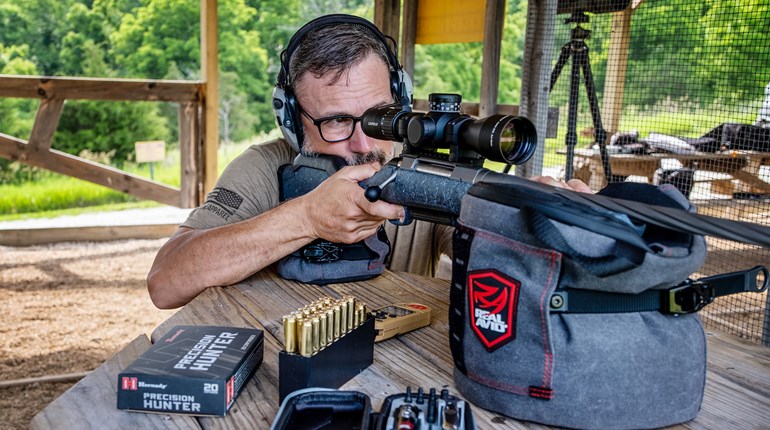
Shooting prone rifle for a little while but looking to improve your position? While steady and smart practice is the way, here are some things to consider that contributed to large steps upward in my position development over the years. To me, prone is all about consistency in the subtle details. Each of the following tips helped me improve upon that goal. Since everyone’s body is different, your experience may vary. Keep in mind that I am right-handed, so please reverse my descriptions if you’re left-handed.
1) Consistency
One of the simplest ways to improve consistency in your prone position is to keep the butt of your rifle in your shoulder between shots. Every time you remove and replace that rifle, a small error is made which will affect your next shot in a way you can’t predict. If you can’t reach to load while keeping both elbows down on the mat, learn to reload by either lifting your trigger arm up or by leaning over slightly. Keep as much in the same place as possible between shots.
2) Keep your gear close
Another great way to keep movement and errors to a minimum while you shoot prone is to place everything you need as close as possible to you. It makes no sense to conduct an upper back workout during your match, doing a rep every shot as you reach to see through your spotting scope a foot above or to the left of your head. Place the scope close enough to your eye that you only need to flick your eyes over or slightly lift or rotate the head to see through it. Similarly, place your ammo, timer, etc. close enough that even someone with tiny T-Rex arms could reach them. Unnecessary movement between shots leads to unnecessarily big groups.
3) Make sure your shooting coat fits
Having a properly fitted coat around the shoulders was one of the most significant improvements to my prone position. You won’t realize what you’re missing until you correct this. Unless you have the build of The Incredible Hulk, most off-the-rack coats will not fit your shoulders! The excess material around the shoulders slips and slides and bunches up in places. You’ll find your position sagging lower and lower with each shot, your sling slipping down your arm, and placing the butt of the rifle consistently in the same place nearly impossible. Your zero will wander and you’ll have unexplained flyers, not to mention the frustration of a position that is constantly changing in its feel. With a coat that hugs your shoulders in position, everything stays in place from shot to shot, allowing more consistency and relaxation. If you can’t afford a custom-fit coat, take your off-the-rack model to a local tailor or shoe repair shop. Anyone with some tailoring know-how and a heavy duty sewing machine for canvas or leather can take in the seams for you.
4) Arm and rifle
I took another step forward in my prone shooting when I changed how I thought about the relationship between my arms and the rifle. For a while, I was placing my sling elbow directly under my rifle, which resulted in a stretch on the outside of that upper arm. There wasn’t much pressure to speak of on my other elbow. While shooting, my position would continually sag lower and to the left as my arm muscle stretched out. I routinely tightened my sling during matches to try and compensate, but this was only a band-aid.
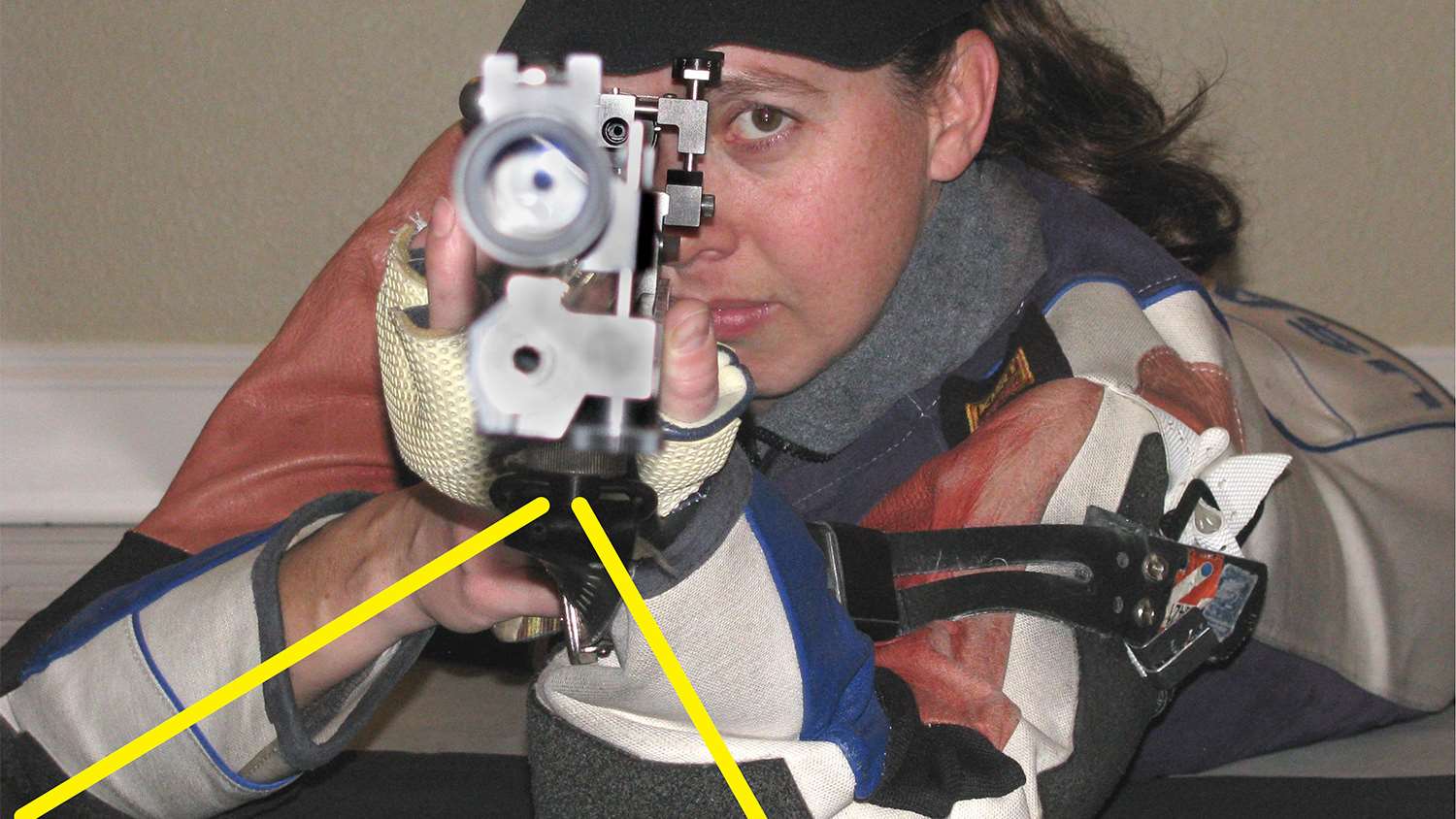
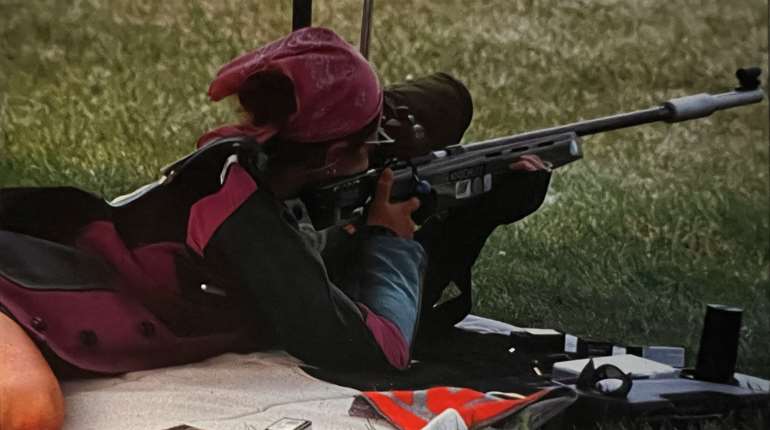
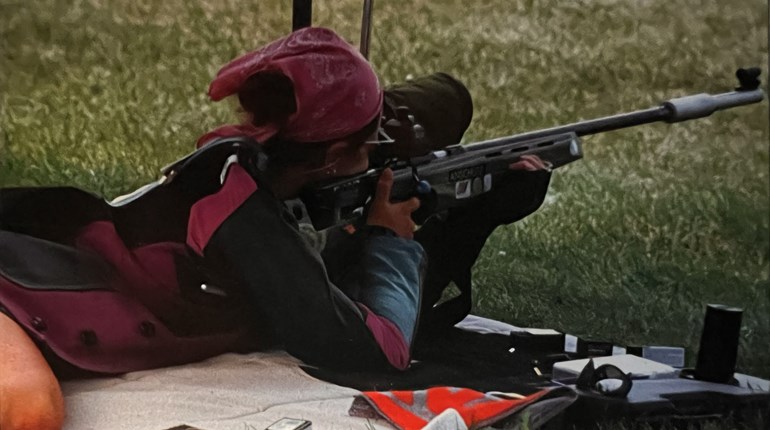
Once while at a national competition, I overheard the then-National Rifle Coach explain to someone how the two forearms should form a triangle with the floor, like a bipod for the rifle. This triangle need not be equilateral; the sling arm may be more vertical than the trigger arm. But essentially, all I needed to do was move my left elbow out from under the rifle. After trying it out, I realized this technique did not stretch my arm and relied purely on bone structure for support—meaning my arm no longer stretched or sagged as I shot my match. My other elbow now has more pressure on the mat as well, which means a more durable position with recoil for me.
5) Sling rotation
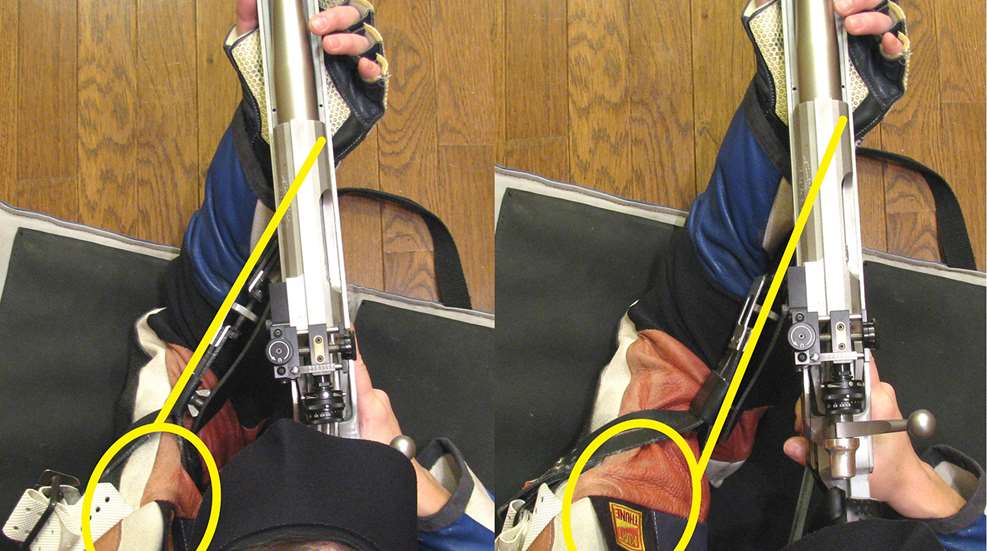
Many people are aware that the sling can be placed at a variety of heights on the arm to find a comfortable place with a minimum of heartbeat. This is most commonly just above the bicep, but sometimes elsewhere. Another factor to consider: the rotation of the sling on the arm. This will affect how the pressure distributes itself on your arm (which affects comfort and heartbeat transmission into the sling) as well as the angle the sling pulls on the rifle. For example, when I rotate the sling toward the inside of my arm, I feel the rifle being pulled a bit to the right, into my right shoulder, reinforcing the bipod concept of my two arms (see the photo at the top of this article). When I rotate the sling toward the outside of my arm, it tends to pull the rifle to the left, which results in a point of aim that wants to drift to the left. You may find something different, or prefer a straight, or neutral, sling. A good sling keeper on your shooting coat will hold the sling consistently at the height and rotation you desire as you shoot.
If you haven’t considered one or more of these ideas, I encourage you to give them a try and see if you observe an improvement to your position!
Photos by Justin Tracy