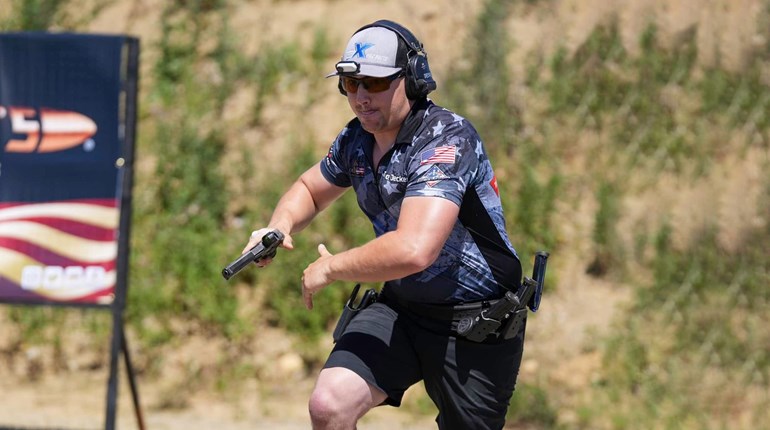
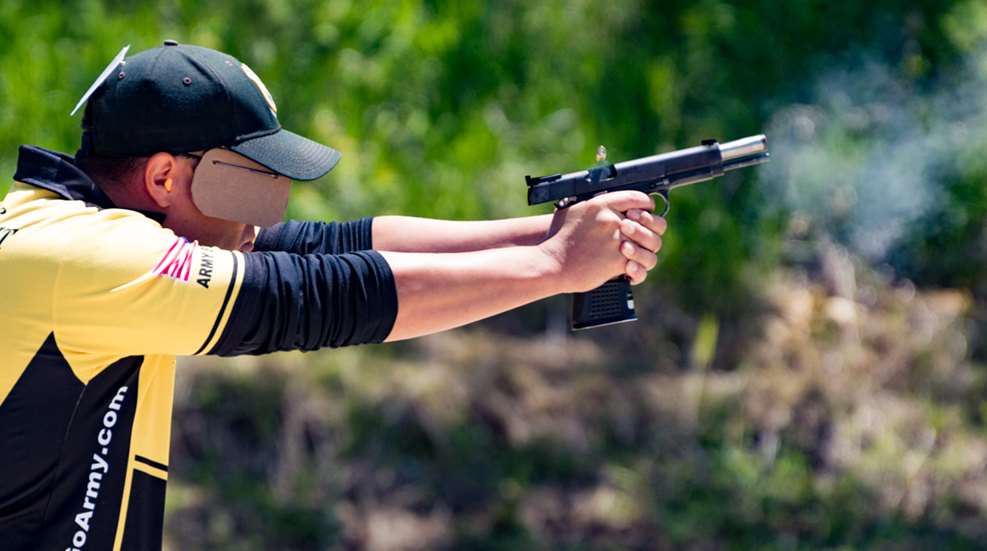
The most basic skill set required of action pistol competitors is the one that will begin over 80 percent of all courses of fire—facing the first target in the array, then drawing and engaging it with two rounds when the buzzer sounds. It looks simple, but it actually requires mastering a complex series of actions that comprise virtually all the handgun fundamentals of stance, draw stroke, presentation, grip, sight alignment, sight picture, trigger press, and recoil control for a follow up shot.
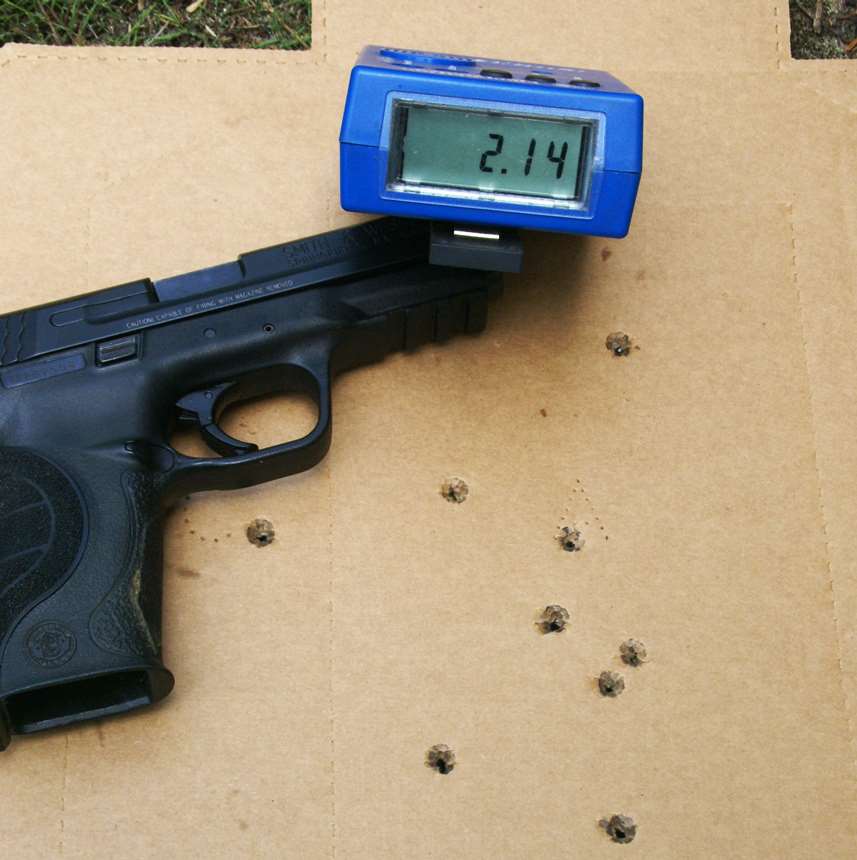
The Double Tap Drill incorporates all of them into one simple, easy to score drill. You will need an electronic timer to realize maximum benefit, but there are models on the market that cost less than a half-dozen boxes of ammo and will pay larger dividends.
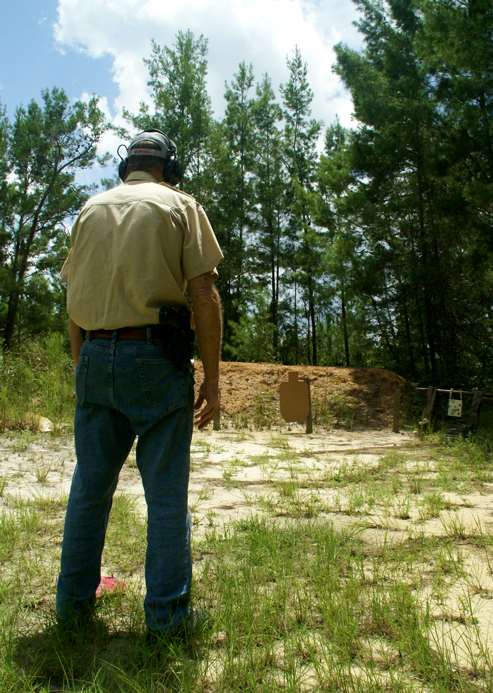
The Double Tap Drill has the shooter facing one target at a time, appropriate for the game being shot (IDPA. USPSA, or ICORE). At the buzzer, the shooter draws and double taps the target. The target distances are 7, 10, 15 and 25-yards. The varying distances will help the shooter establish the rhythm and sight picture required to make accurate hits at different ranges.
The normal start position has the hands relaxed at the shooter's side. But the “Surrender Position” will crop up in all action pistol matches and should also be practiced. This position requires the shooter’s wrists be held above the shoulders until the buzzer sounds. Experienced competitors often assume this position by bringing the splayed fingers of both hands into contact with their ear protectors to achieve a consistent start position.
A scoring system is needed to chart progress, and these games are scored on time (measured via an electronic timer) plus target score. It's a blend of speed and accuracy. Sacrificing one to enhance the other will hurt your score. While we would all like perfect “no penalty hits,” they're not always needed to score well. In fact, taking the time to drill two perfect hits at 25-yards can actually hurt your score in a match. For example, in IDPA a -1 zone hit adds half a second to your score. If it takes you an extra couple of seconds to make two perfect -0s hit instead of -1s, you've added a full second to your score. As the targets get closer the reverse becomes true. The time it takes to make a perfect hit is less than the scoring penalty.
A realistic scoring system is the percentage of hits between -0/-1 (IDPA), A/C (USPSA) and A/B (ICORE). Only hits in those scoring zones count. Any hits outside them is a drill failure. A 50 percent hit factor would be an even split between the two zones. A 70 percent hit rate would be seven out of ten in the no penalty scoring zone.
This scoring system blends the speed and accuracy required to excel in the action pistol games. And the timer and target don't lie. They can be the coach who is always with you. Are you bobbling the draw? Maybe you need to adjust the holster position. Is the gun coming on target too far right or left? Adjust your stance. Gun coming onto the target with the sights too high or low? Adjust your grip and wrist angle. If you analyze your hits on the target, and the time it took you to make them, you can make the changes to improve.
You’ll know you're approaching Master Class when you can consistently achieve the following scores: 25-yards: under 2.65 seconds, with no worse than 50 percent hits. At 15-yards: under 2.25 seconds with 70 percent. Ten-yards needs to be under 2.00 seconds with 90 percent hits, and at seven-yards you want to be under 1.6 seconds with 100 percent hits.
This drill can be shot with semi-autos or revolvers. At 7, 10 and 15-yards the times are the same. At 25-yards adding .25 seconds for the longer revolver split time is fair. If you are practicing for IDPA with a concealment garment, an extra .20 seconds is realistic at all distances.
These scores won't happen overnight. Upper-level shooters aren't born, they're made. The Double Trap Drill will start you on that path.