From the June 1955 issue of American Rifleman, a question and answer session reviewing the effects of cant.
While I have seen answers giving the effect of cant for certain cartridges at a given range, I would like to have an explanation which will be adequate for determining this effect with any cartridge at any range.—George A. Williams, Brooklyn, NY.
Answer by E.H. Harrison: The effect of canting the rifle in firing is to move the impact of the bullet on the target in the direction of the cant, and also slightly downward.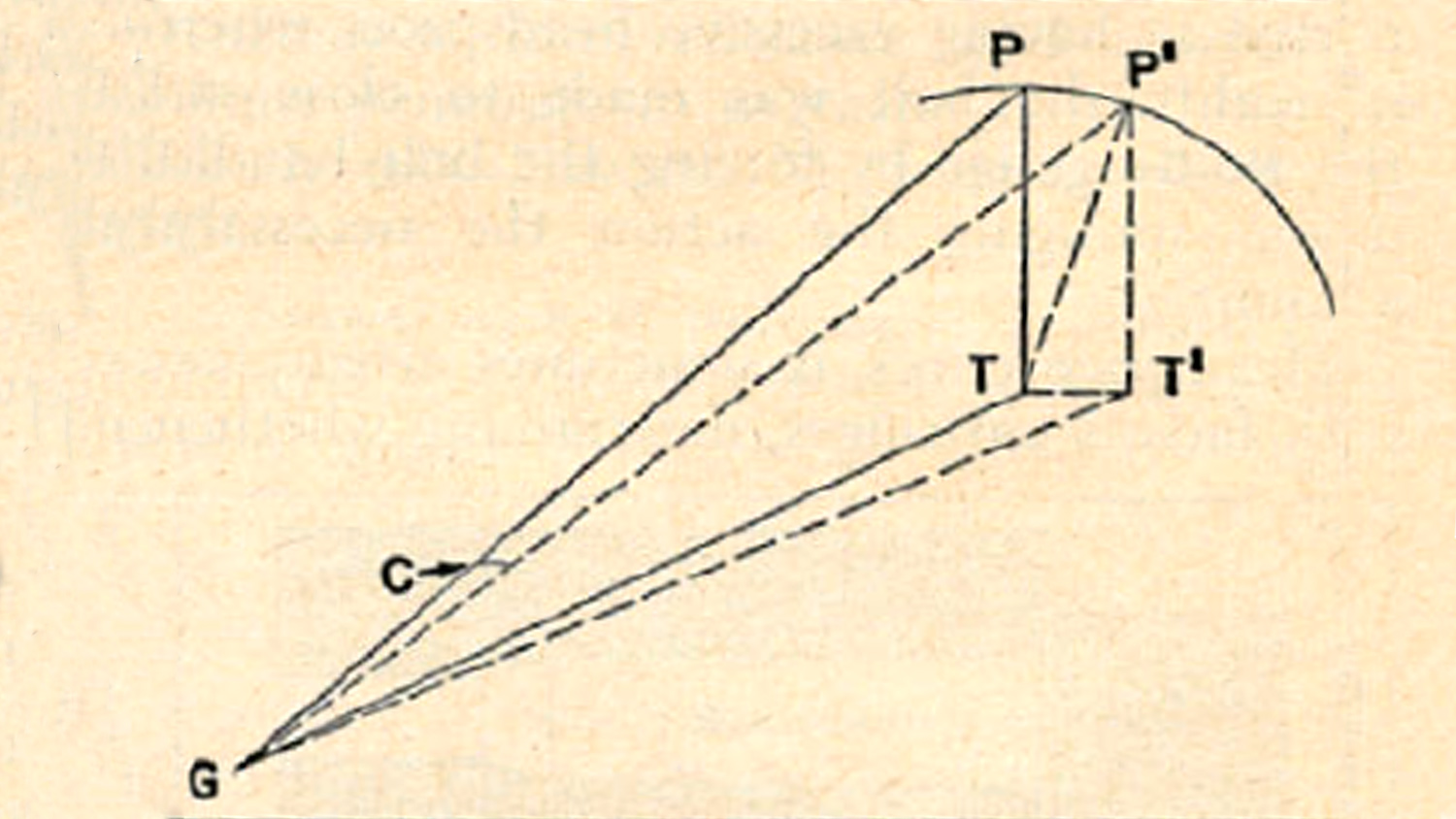
The above illustration shows in perspective the effect of cant when firing at a vertical target with its center at the point T. The gun is at G, and the line GT is therefore the range. Because of the curvature of the trajectory resulting from gravity, the bullet must be discharged at an angle above the line to the target, and in the figure the point toward which the bullet must be discharged is P. If, for example, the rifle is canted to the right, the result is to discharge the bullet in the direction of the point P′. This obviously will result in the bullet striking to the right of the center of the target and also slightly lower. The latter effect is trifling and can be ignored, and the important result is to move the strike of the bullet from T to T′. We see that the magnitude of the effect is dependent on both the angle of elevation (which governs the height PT) and the angle through which the rifle is canted.
We can determine the total effect on the target from the magnitudes of the above two factors. PT obviously depends on the range and the angle of elevation. The sportsman seldom knows the latter, but he can obtain PT from the approximate relation that it is four times the midrange trajectory height. Trajectory heights for various factory loads at ranges up to 300 yards are given in factory ballistic tables. For example, the midrange height of the factory .270 Winchester 150-grain load when shooting at 300 yards is 7.8 inches, hence the height PT under those conditions is about 31 inches.
For the effect of the angle of cant C, note that the distance TT′ (which is the displacement on the target we are looking for) is given by the relation TT′ = PT sine C. The values of the sines of angles 1° to 6° are: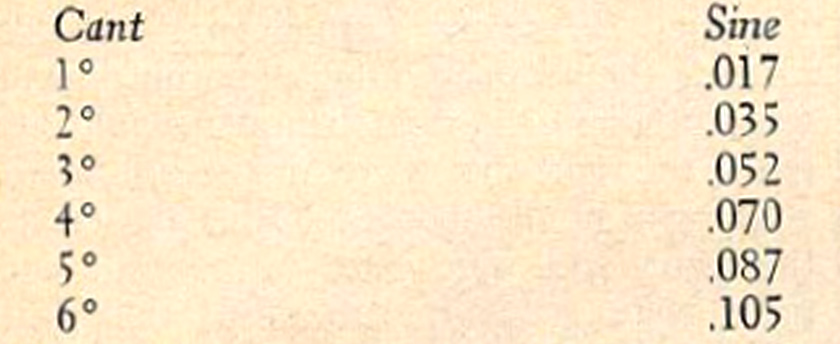
If in this case we cant the rifle 5° to the right, the displacement of the hilt will be 31 times .087 or about 2½ inches to the right.
In the above way the effect of cant can be readily computed for any cartridge of known ballistics. We see that at long ranges or with cartridges giving quite curved trajectories, the lateral displacement on the target can be considerable. This is notably the case with the .22 long rifle.