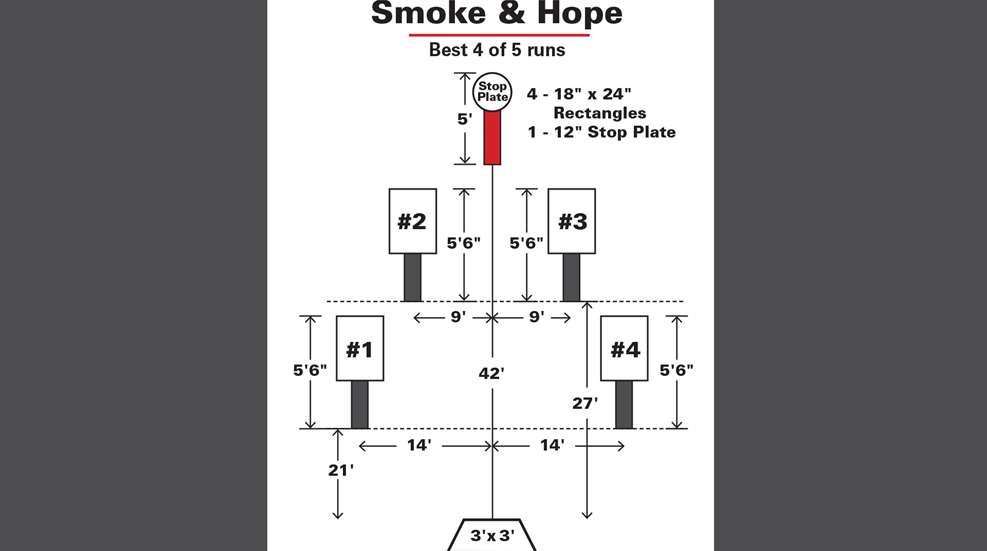
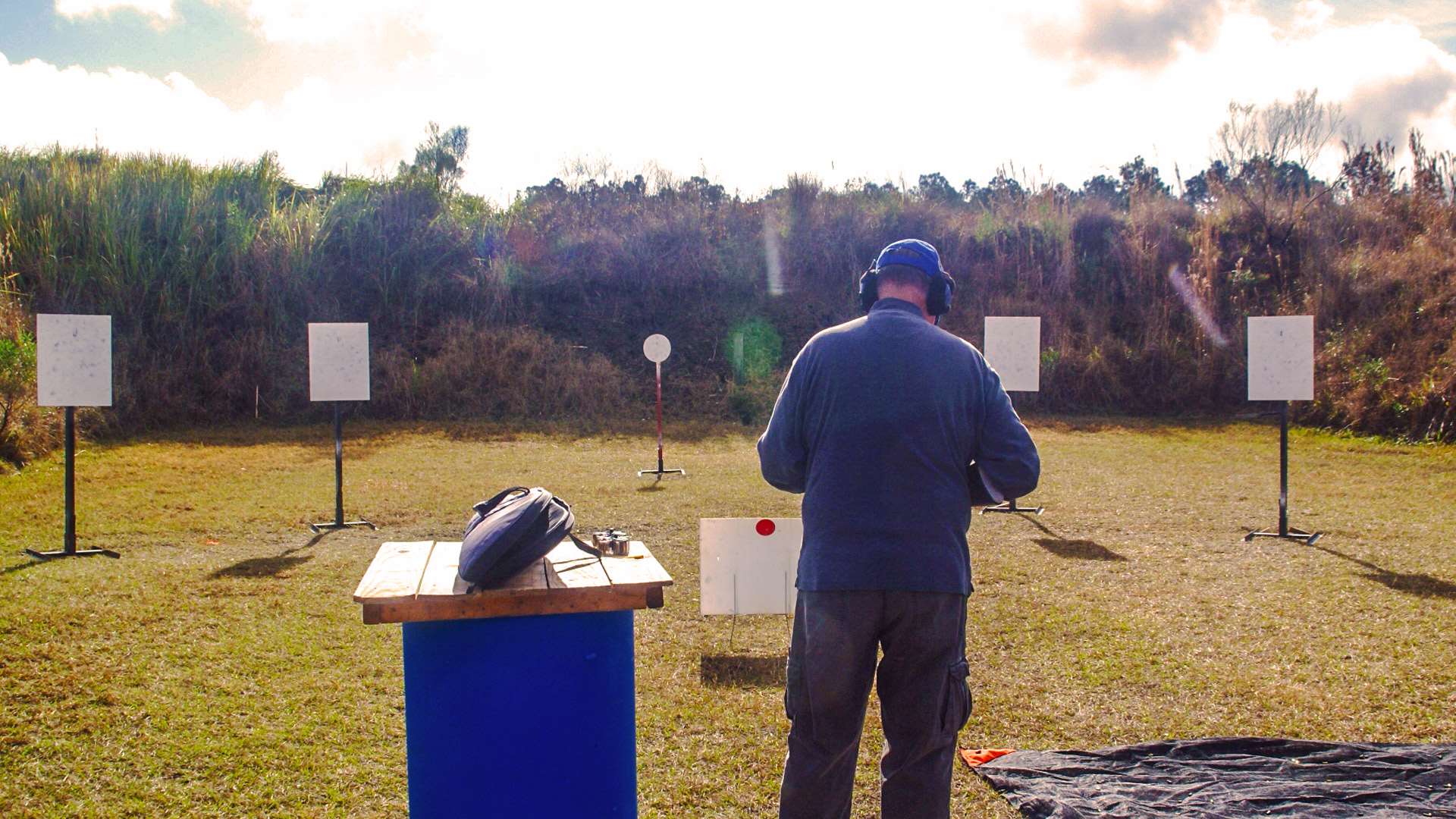
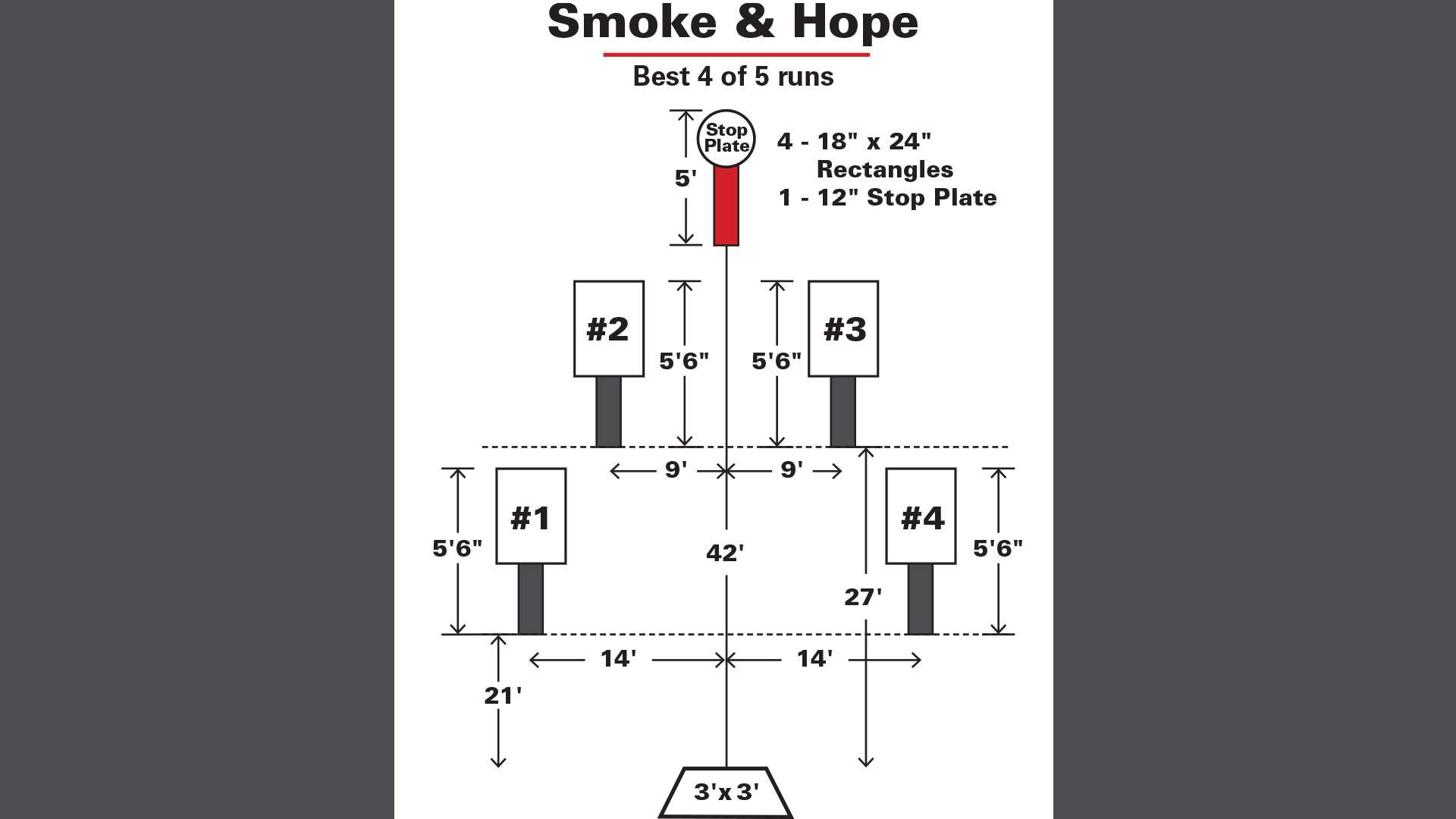
In Steel Challenge competition, Smoke & Hope (SC-103) is one of the fastest stages. A casual glance shows why. The four Option plates are 18x24-inch ones and set at seven and 10 yards to the shooter’s right and left. They're big enough and close enough that it's more point-shooting than aiming. Many optics shooters don’t even look for the dot, they just want to see a window full of white. Iron-sight shooters often point-shoot them using only the front sight.
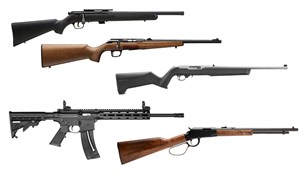
The fastest Peak Time for this stage is 7.00 seconds (1.75 average) and is shared by Pistol Caliber Carbine Open (PCCO), Rimfire Rifle Open (RFRO) and Rimfire Pistol Open (RFPO). The slowest is 10.50 seconds for Iron Sight Revolver (ISR, 2.62 average). That’s lightning-fast, and probably where the “Smoke” portion of the name came from.
However, that changes after the shooter nails those and has to deal with the center 12-inch Stop plate at 14 yards. That’s a long reverse transition to a smaller, more distant target. Aiming is required here. Shifting from pure from speed to precision is critical. That’s likely where the “Hope” part came from.
The key to Smoke & Hope is to choose the path through the Option plates that gets you to the Stop plate in the most positive manner. It’s obviously the toughest target, and where experienced shooters set their natural point of aim. Beyond that there are a number of options that can be effective, and there is no clear consensus as to which is best.
I find that I come to the Stop plate more effectively from the right to left, so No. 1, No. 2, No. 3, No. 4, Stop works for me. The advantage to this order is that if I miss No. 3 on the long transition, I can pick it up without breaking my rhythm as I transition back to the Stop plate. This is a common way to shoot it. Those who prefer to come to the Stop plate from the left use a No. 4, No. 3, No. 2, No. 1, Stop, with the same advantage in picking up a missed No. 2 on the Stop plate transition.
Another popular option is No. 3, No. 4, No. 2, No. 1, Stop (or the reverse of No. 2, No. 1, No. 3, No. 4, Stop). Some shooters feel this brings them onto their first plate more quickly than targeting the outer plates and makes up for the time loss on the added reverse transition, as well as providing for a miss on No. 2 or No. 3. An option to this is No. 3, No. 4, No. 1, No. 2, Stop (or the reverse No. 2, No. 1, No. 4, No. 3, Stop). Shooters using this order feel the transition to the Stop plate is shorter and quicker. The drawback is that missing No. 3 or No. 2 on the way to the Stop plate will trash that string.
Cleaning the Option plates quickly does a shooter little good if they miss the Stop plate and have to keep tossing rounds at it. Getting a quick hit on the Stop plate in the smallest number of seconds is critical. The timer doesn’t lie. Whichever option works best for the shooter is the way to master this stage.
Be sure to read our past breakdowns of the Five To Go and Speed Option stages. Next month, we’ll review the Roundabout stage. Learn more about Steel Challenge at scsa.org.
Read more: 4 Key Things To Do Before Your First Match