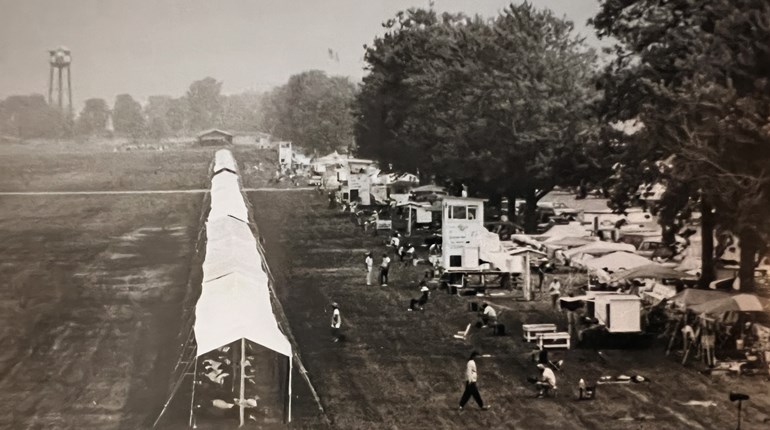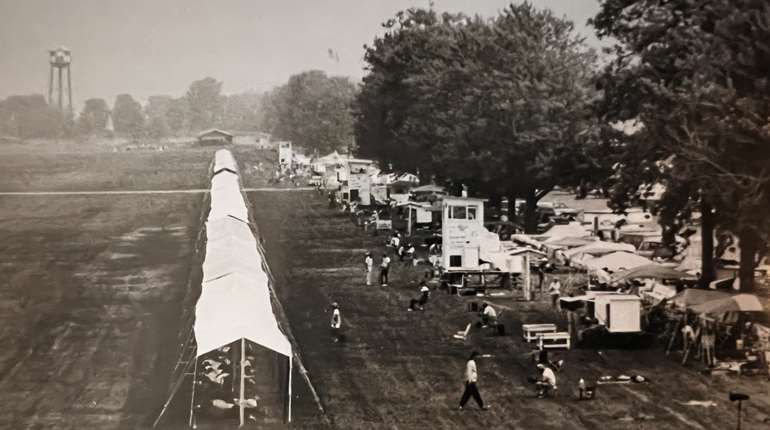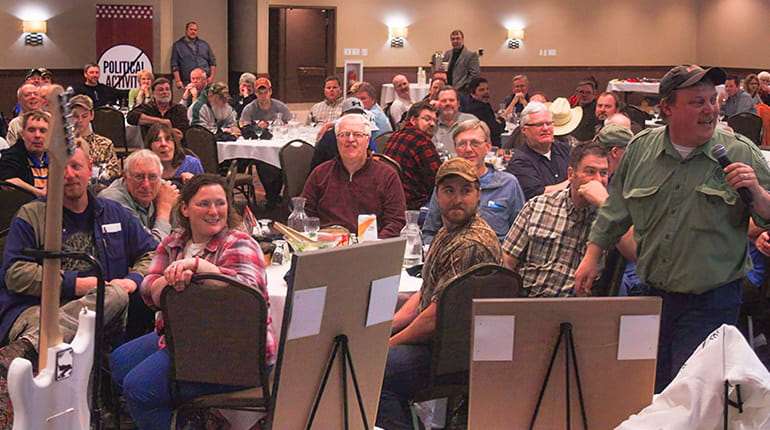
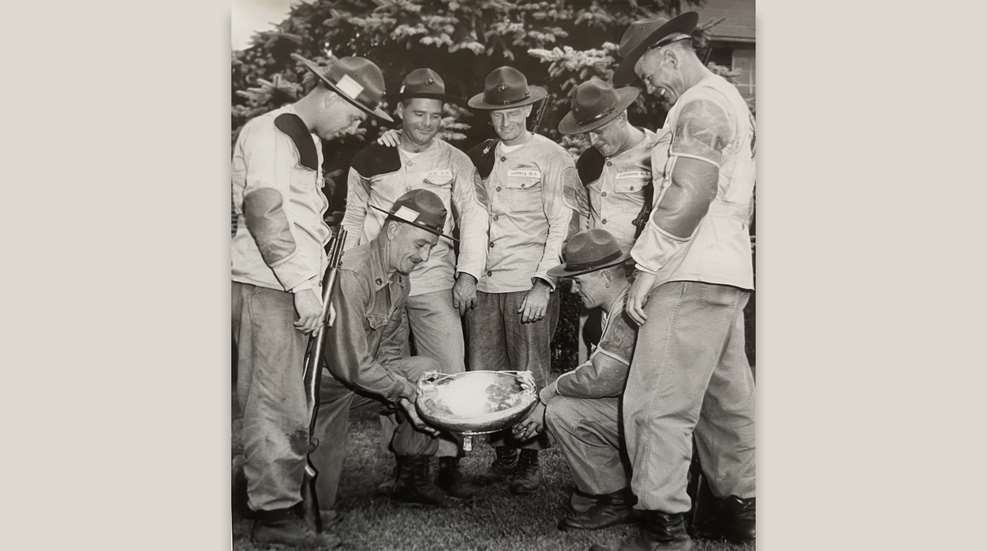
“The [Wimbledon shoot-off] developed more spectator interest than any other single fired match in recent history of Camp Perry. The shoot-off was advertised by a mobile public address unit throughout camp … behind the 20 key firing points were filled with spectators … To add a final touch to the shoot-off, two free-fall parachutists gave demonstration jumps immediately in front of the bleachers.”
—The American Rifleman, October 1961
Immediately after the 1960 National Matches, work began on range expansion for all three types of shooting and improvements to other facilities were either completed or underway when competitors arrived in 1961—the first time in National Match history that attendance exceeded 6,000.
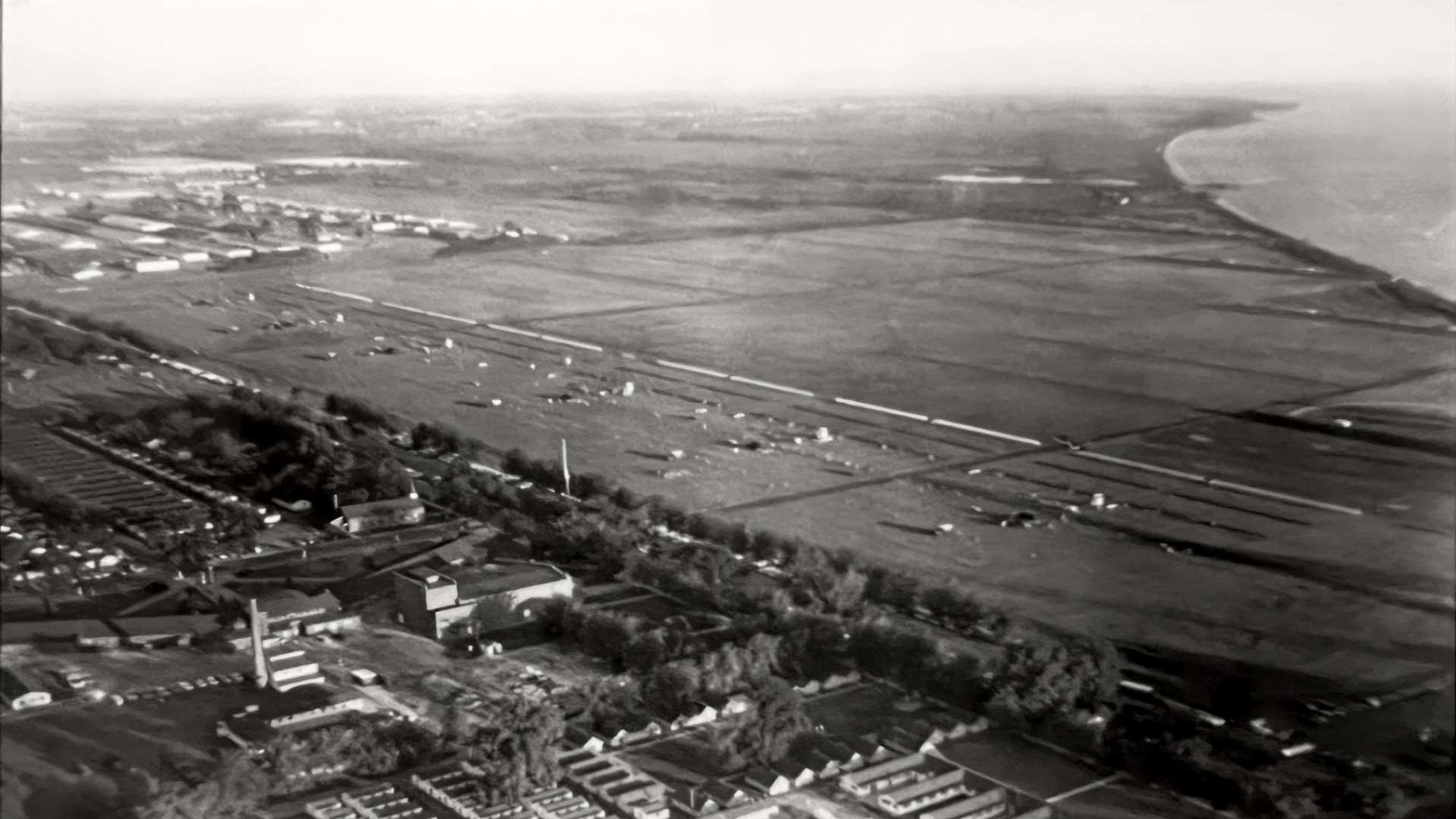
Among the range changes was the addition of 100 pistol targets next to the Erie Ordnance Depot for a total of 600 to accommodate a maximum of 2,400 competitors. For high power, the pits on Viale Range were rebuilt with targets moved closer together to allow for 45 more, while behind the firing lines, administration facilities were renovated with a combination of federal and state funds. Road widening along Commercial Row also took place, as did the installation of more sidewalks, a far-reaching storm sewer drainage system, and one of the most popular improvements in the minds of competitors—an all-weather parking area immediately behind the ranges.
A more critical refurbishment that affected competitors was the re-roofing and re-wiring of living accommodations and, by the start of the 1961 matches, asbestos shingling had been applied to about one-third of hutment exteriors.
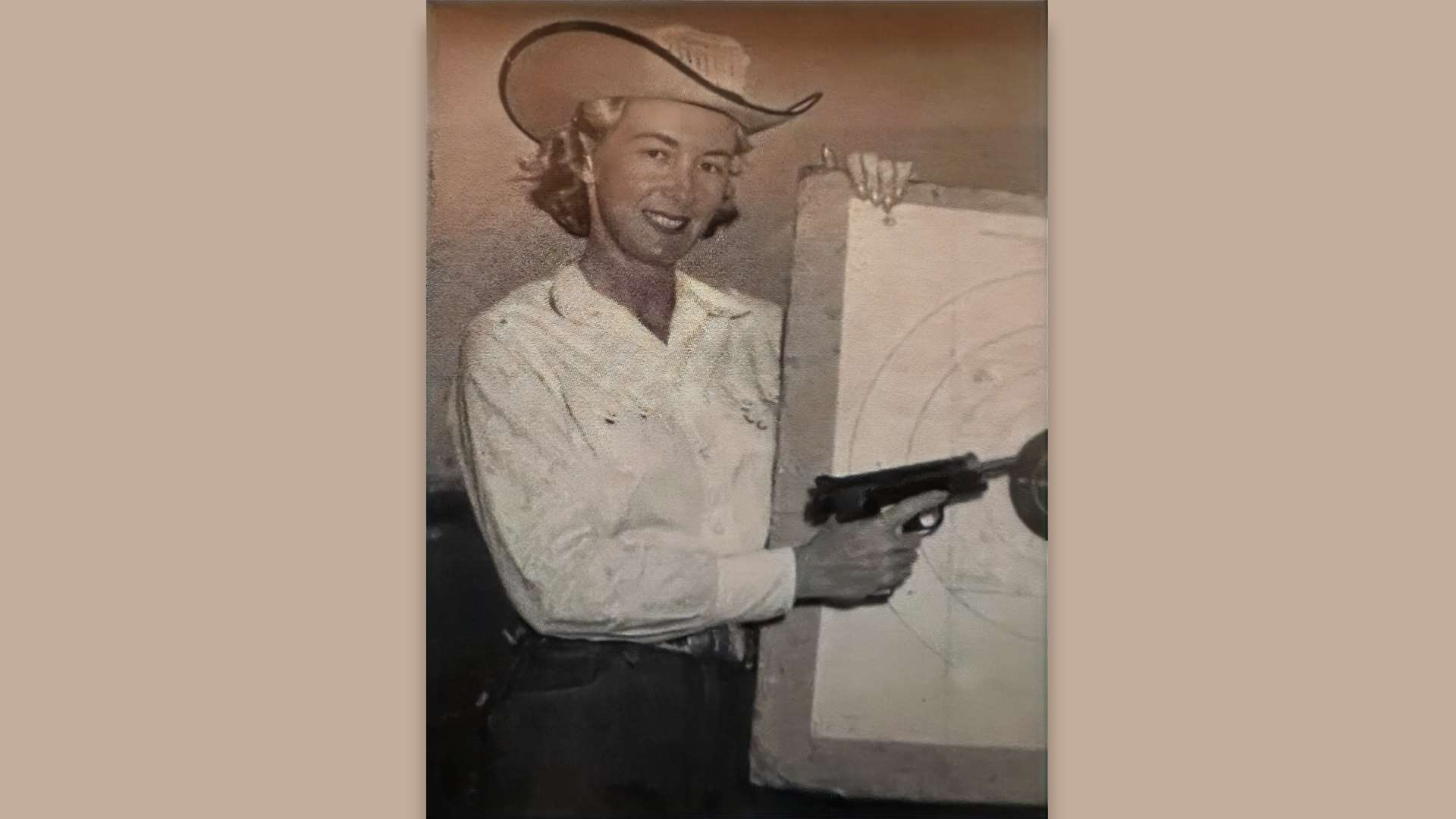
Title defenses were the name of the game in pistol as the Army’s Sgt. 1st Class William Blankenship, Jr., won his second consecutive championship with a 2631-119X, and Lucile Chambliss topped the women’s field again for her second straight (third overall) championship. The Army repeated as National Trophy Pistol Team champions, while in the other Board-sponsored match, the U.S. Coast Guard provided a new face on the pistol winner’s podium in the form of Petty Officer 1st Class Stanford Hulstrom.
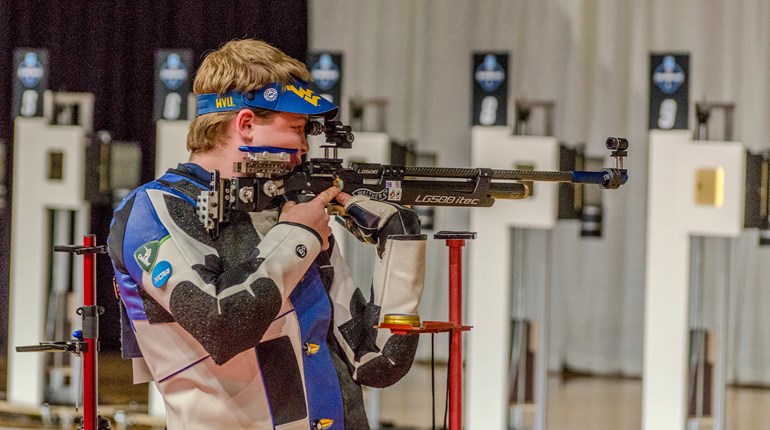
In addition to the many physical changes at Camp Perry in 1961, smallbore shooters experienced changes in both prone and position courses of fire. The prone championship aggregate was reduced from 6400 to 4800 points, while 50-meter firing was eliminated from the position competition and the 1600-point championship was decided entirely by four 50-yard matches. Unlike past years, however, no clear-cut leader emerged for the prone championship. No one person won more than one match and the winners of the metallic-sight and any-sight championships did not claim any. After the two 1600-point aggregates were completed, the new championship course of fire required an additional four matches under the general title of Prone Team Fund Aggregate: twice across a Dewar and two 100-yard matches; once with irons and once with any sights.
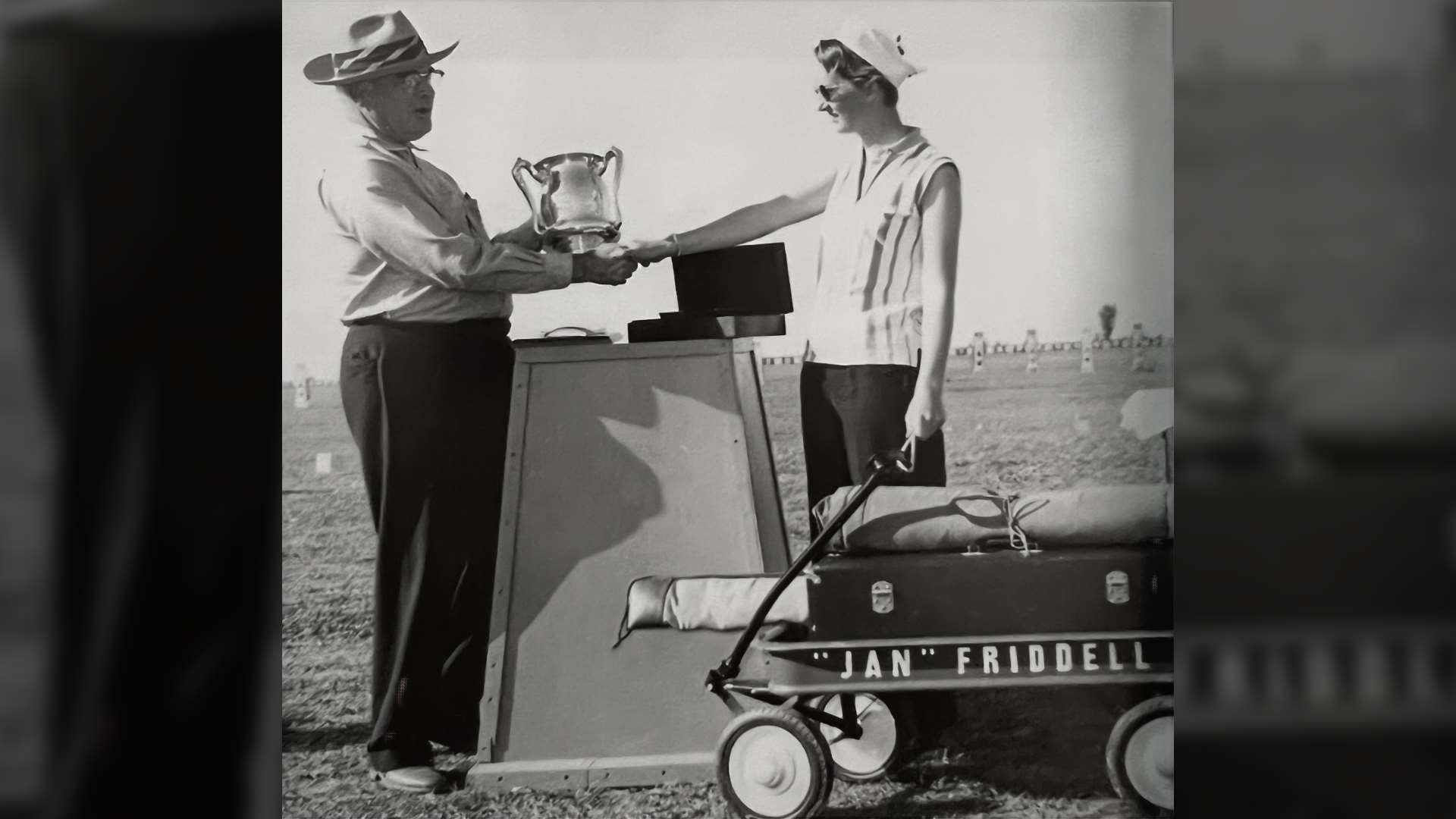
The national collegiate champion from 1960, Victor Auer of Sherman Oaks, California, was the shooter who, as a member of the U.S. Air Force team, emerged in 1961 to claim both open and service prone titles with a 4784-359X. Janet Friddell of Toledo, Ohio, captured her second women’s title in what turned out to be a prelude to a tremendous display of skill in the various international team matches. Friddell was busy on team day as she was named to the Randle, Dewar and Pershing Teams—a trifecta unheard of up to this year and a challenge that Friddell was prepared for. She opened the day with a high team score of 400-29X in the winning Randle effort and after shifting her equipment to her point for the Dewar Match, fired a 388, just one point shy of the high team score in a contest that went to Great Britain. After a break, Friddell reloaded her block and shot the only perfect score (400-27X) on the victorious Pershing Team.
Lt. Tommy Pool of the Army Marksmanship Training Unit took the position warm-up match and never relinquished control, despite the efforts of teammate Cpl. Gary Anderson, who fired a National Match metallic-sight record 395-21X. Pool held fast and fired his own any-sight record score of 397-22X to secure the overall position title with 1567-79X. Jilann Brunett was denied a second collegiate title at the hands of Carl Guenther of Fond Du Lac, Wisconsin, but she garnered her fourth straight women’s title in 1961, while Fred Johnson of Joliet, Illinois, who had competed at Camp Perry since the 1920s and was a Dewar Team veteran, took the senior title. Civilian and junior honors went to the same shooter as Mack Hodges, III, of Arlington, Virginia, tallied a score that fell just 10 points shy of Pool.
As had been the custom since 1958, the high power phase opened with the firing of the President’s Match and Marine Warrant Officer Emmett Duncan topped the field just as he had done six years prior. And beyond the titles claimed by California civilians Jay Harris (NRA high power championship) and Earl Burton (Wimbledon Cup), Army shooters grabbed most of the spoils. The service rifle title in the high power championship went to Sgt. Charles Davis, while teammates Capt. Verle Wright, Jr., and Sgt. 1st Class Alfred Falcon earned top honors in the Leech Cup and National Trophy Individual event, respectively. As a team, the Army won both the National and Infantry Trophy Matches for the fifth straight year in addition to the Herrick, Nevada, Romanian and Enlisted Men’s events.
1961 National Matches Fact
Warm-Up Aggregates were introduced in 1961 for all three shooting disciplines with entry fees credited to the NRA International Shooting Fund to help with expenses of U.S. international teams.