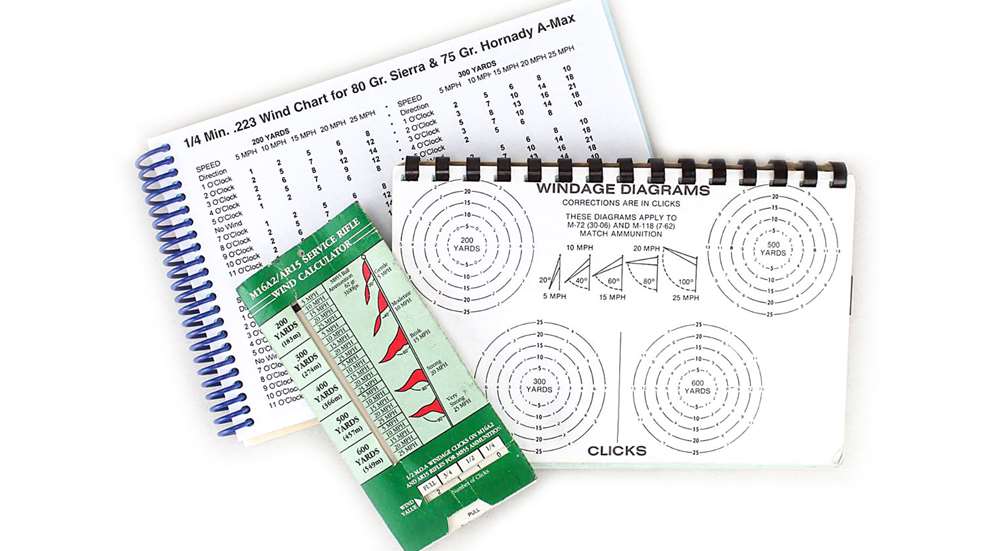
Quick figuring in your head, what is 10 times five divided by 12? Now, how many clicks is that on the sight of your high-power rifle? OK, let’s make it easier: what is 10 times five divided by 10? The difference here is the difference in marksmanship training between the U.S. Army and Marine Corps in 1940 on adjusting a rear sight to compensate for wind. Though the disparity in these rules-of-thumb sometimes confused civilian competitors, there’s a (likely) logical reason for the difference in the rules, but how can they both work?
Instant headwork
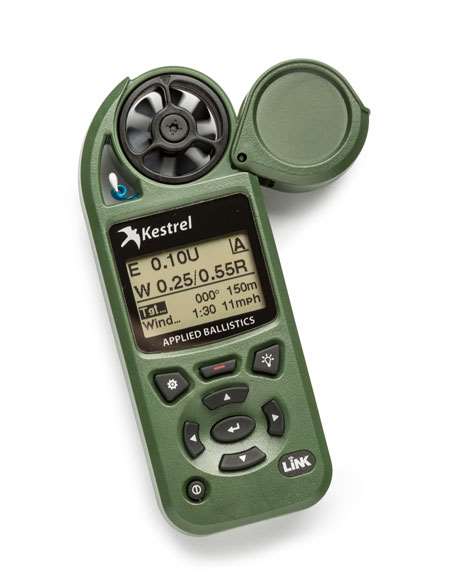
Today’s military and civilian high-power shooters enjoy futuristic aids to marksmanship unimagined at the brink of WWII, aids such as comparatively low-recoiling service rifles, magnifying optics with lighted reticles, hand-held electronic sensors that precisely measure wind speed and mobile-app ballistic calculators. Making some headway into the U.S. game now are electronic targets that automatically tabulate scores for shooters. While competitors rely more on technology to raise their scores, the wind blows pretty much the same in 2019 as it did in 1940 and we still must compensate for it.
Combat soldiers and Marines, of course, trained without the luxuries of competition gear. They had to solve challenges to marksmanship immediately and under stressful conditions. A “quarter point” rule-of-thumb technique for quickly compensating for wind evolved on the shooting range, was adopted for combat and went back to the range in High Power competition. The U.S. Army’s “Infantry Drill Regulations” published in 1940 explained the quarter-point system.
“The range in hundreds of yards times the velocity of the wind in miles per hour, divided by 10, is the number of quarter points of wind-gauge correction to allow for a 3 or 9 o’clock wind. Winds one hour from 3 to 9 o’clock (2, 4, 8, 10 o’clock) require almost the same windage. Winds one hour from 6 or 12 o’clock (5, 7, 11, 1 o’clock) require half as much windage as a 3 or 9 o’clock wind.”
Competitors today speak of full-value or half-value winds. The 1940 term “quarter point” apparently refers to the quarter from which the wind is blowing. The Marine Corps adopted a nearly identical quarter-point system, but used 12 rather than 10 as the divisor. Certainly, we can all mentally divide by 10 much quicker than we can divide by 12, so why did the Marines make it a wee bit more difficult?
Changing ammo—again
The answer may lie in the changeover in .30-caliber service-rifle ammunition between the two World Wars. Recall that the .30-06 government cartridge started life as the .30-03, a 220-grain FMJ bullet with a muzzle velocity of 2,300-2,400 fps. Keeping up with the faster and flatter Joneses in Europe, the .30-03 underwent modification with a shorter neck and a lighter 150-grain flat-base FMJ bullet at 2,700 fps and began service in 1906 as “Cartridge, Ball, Caliber .30, Model of 1906”—better known as the .30-06. During WWI, Americans discovered their machine guns could only effectively throw the .30-06 bullet about 3,800 yards while the enemy’s guns were effective out to approximately 5,000 yards. “Barrage fire” from machine guns into a distant enemy was an important infantry tactic in WWI, and the U.S. Army needed to change service ammo again to avoid being outgunned.
It took a while, but by 1926 the Army had changed the .30-06 cartridge to launch a 172-grain boattail spitzer bullet at about 2,650 fps to extend machine-gun range. This version bore the moniker, “M1 Ball.” But the cartridge’s recoil in the Springfield was felt to be excessive, the cartridge thought too powerful for safely shooting on smaller shooting ranges, and apparently machine-gun barrage fire fell from favor as a primary tactic. By 1940, the cartridge bullet was scaled back to a 152-grain flat base FMJ spitzer bumped up to 2,800 fps, and became the standard M2 Ball round used until the .30-06 retired from U.S. military service decades later.
Two Balls, two rules
1940 also marks the same year that the Army and Marine Corps published their manuals training men in marksmanship with the service rifle. It appears that the difference in quarter-point divisors, 10 for the Army and 12 for the Marines, might be traced to the change from M1 Ball to M2 Ball, with the Marines’ quarter points based on the former and the Army’s on the latter. Again, M1 Ball had a 172-grain boattail bullet, and the M2 Ball a 152-grain flat-base bullet; with different weights, muzzle velocities and ballistic coefficients. Of course they won’t both fly precisely the same, with the lighter, lower-BC M2-Ball bullet falling behind in performance at extended ranges.
Whether on a shooting range or in combat the differences work out like this, with the 150-grain bullet M1906 ammunition in the first column as a baseline reference:
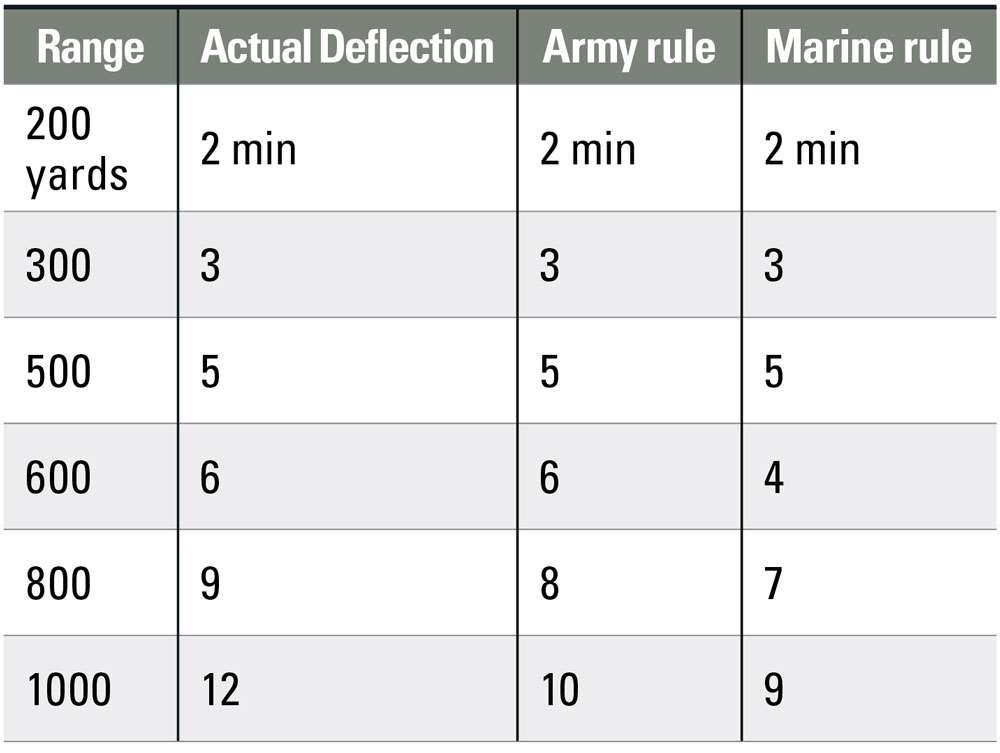
Because the heavier boattail bullet of the M1 Ball would theoretically be less affected by the wind at longer ranges than would M2 Ball’s 152-grain flat-base bullet, it would require less quarter-point adjustment, and that’s what we see reflected in the chart.
But is it true? Did the Army and Marine Corps base their quarter-point rules on the different service-rifle ammunition? I didn’t find a definitive flat statement published by a credible source saying so, but it seems possible, if not inarguably probable. Taking advantage of one of our futuristic aids, running the BC and muzzle velocities of the three loads through the online Federal Ammunition Ballistics Calculator showed that wind drift at 1,000 yards for the M1906 and M2 Ball loads is 12 and 12.5 minutes respectively, and for the M1 Ball, 9.8 minutes. Taking into account the usual shooting and cartridge variables and the improvement in calculating technology today, this perhaps also suggests the Army used M2 Ball and the Marines, M1 Ball for their ballpark figures.
Military and civilian high-power shooters used to have a closer collaboration than they do today, and the difference in Army and Marine quarter points was sometimes cause for confusion back in the day. However, in the real world of 200-, 300- and 600-yard across-the-course competition, it appears the one worked equally well as the other as a guide.
Except, for most of us, it’s far easier to divide by 10.
Resources
- Col. Townsend Whelen, Days of the Springfield, Gun Digest 1961
- E.H. Harrison, Dope Bag, American Rifleman, May 1956
- The New Infantry Drill Regulations, United States Army, 1940
- Michael Bussard, Ammo Encyclopedia, 6th Edition
- Wikipedia, .30-06 Springfield
- Federal Ammunition Ballistic Calculator
See more: Effects Of Wind And Weather