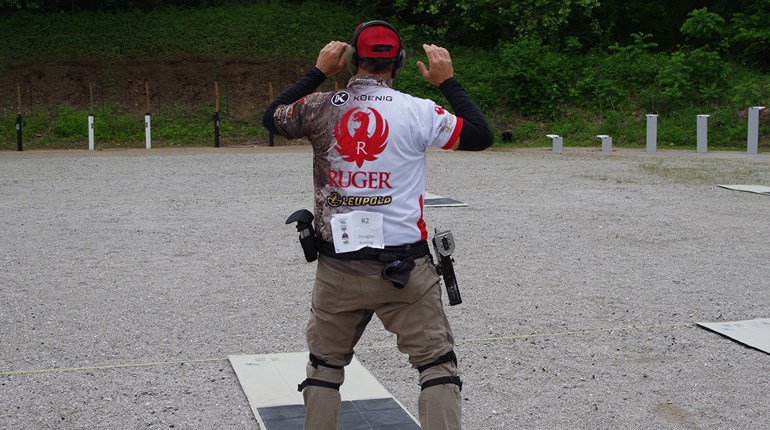
It’s a rare competitive shooter who has not heard of Doug Koenig. From his first match in 1986 at the age of 17, the current captain of Team Ruger has earned an impressive reputation with more than 70 National and World Championship titles—including 18 Bianchi Cup wins, three-time SCSA World Champion and 2016 NRA World Shooting Champion, among many others.
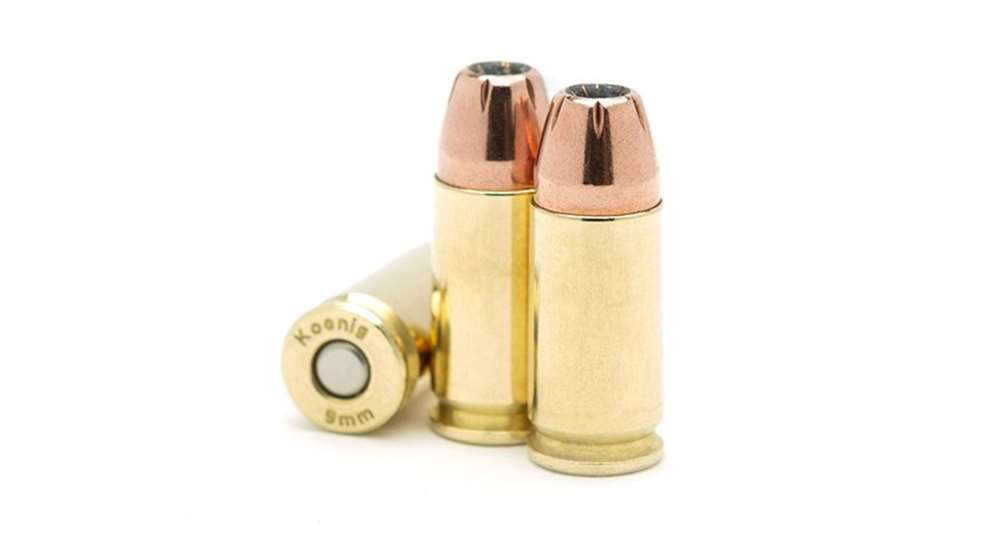
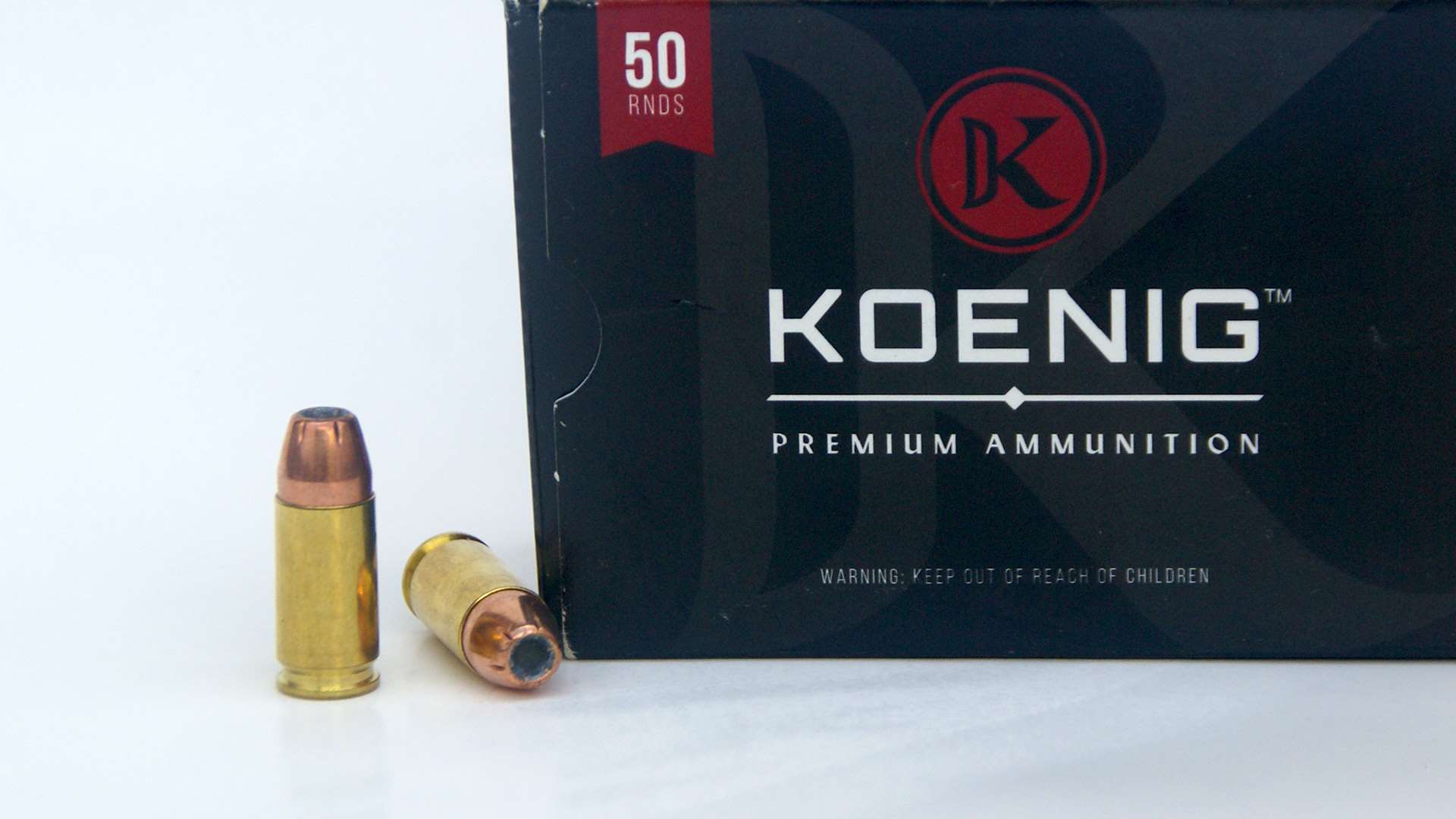
That shooting expertise led to the founding of Koenig Shooting Sports, which produces products that help competitive shooters better their game. Among them is the 9mm Competition load ($19.99 per box). This is a 110-grain JHP bullet at an advertised 1150+ f.p.s., although the barrel length is not given.
I was supplied with some and used it in test reports on a CMMG 9mm PCC and a Smith & Wesson Performance Center M&P. It worked well in those for the few rounds fired. I was then asked to give it a thorough “wringing out.”
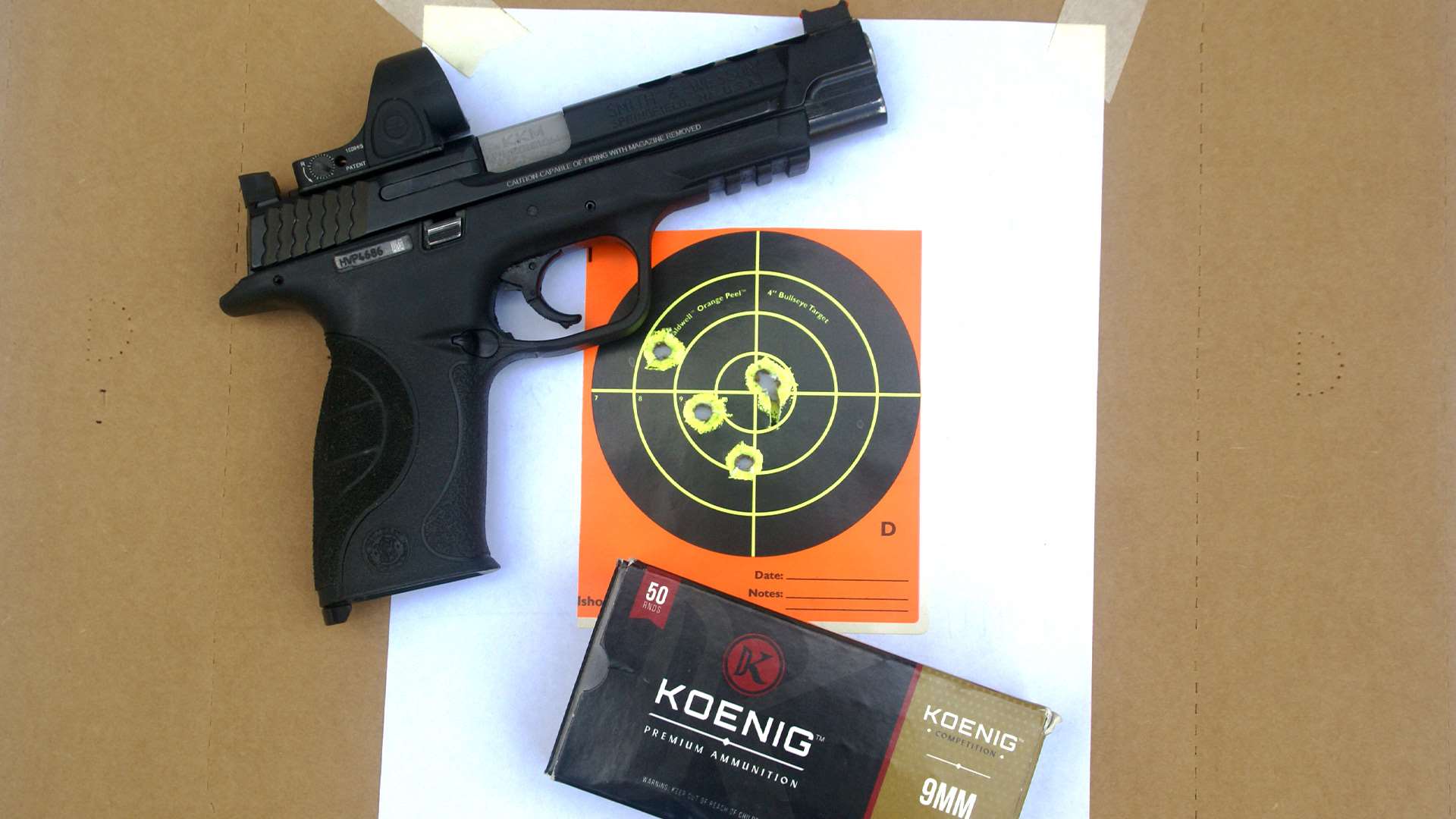
I wanted a variety of barrel lengths and barrel twist rates in the mix, so I selected three guns I’ve had a lot of match experience with. They were a M&P Standard 9mm with a 4.25-inch barrel in 1:10-inch twist, a 5-inch M&P C.O.R.E. with a Trijicon SRO 5 MOA reflex sight and KKM 1:16-inch twist barrel, and a Ruger PC9 Carbine (16.12-inch barrel in 1:10-inch twist) with a SIG Romeo1 6 MOA reflex sight. None of these were involved in my earlier tests.
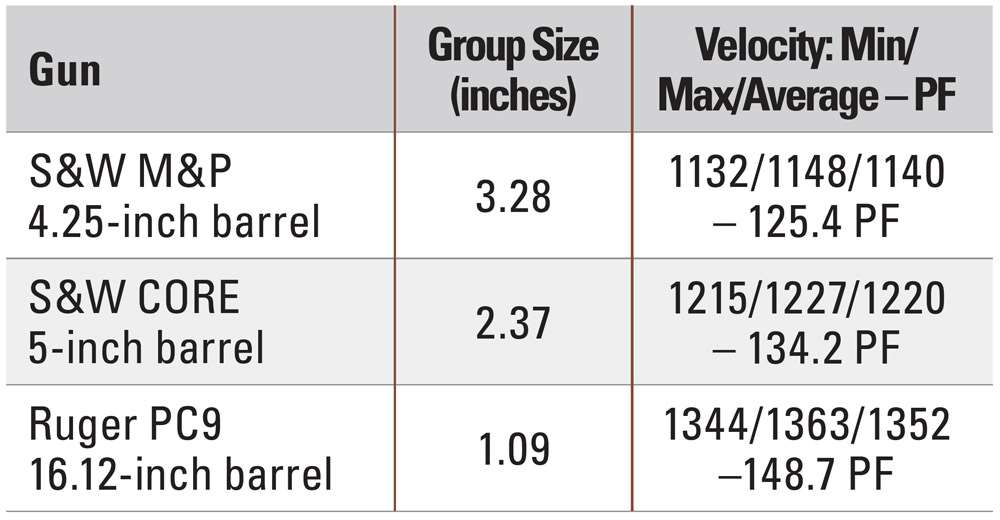
I began accuracy testing from the 25-yard bench on my range with the 4.25-inch M&P. After much ammo testing, this gun has shown itself to be a 3-inch gun with favorite loads, with 3.5-plus inches more the norm. The average groups from the Koenig loads were definitely in the “good zone.” The C.O.R.E. was next. Its best load will do 2.25 inches and this ammo wasn’t much above that. With the PC9, the best load produced a group-size of 0.86 inches. Most fall into the 1.25- to 1.40-inch range. The accuracy chart shows that Koenig ammunition wasn’t the best, but wasn’t far off.
As I expected, the recoil was the “snap” one gets when light bullets are driven to appropriate Power Factor (PF) velocities, although it seemed a bit less snappy than 115- and 124-grain loads.
Accuracy, however, is only half the competition equation. The load must also make the required PF for the gun division being shot. The 9mm normally requires a 125 PF in USPSA and IDPA. If the load doesn’t make the PF, accuracy becomes meaningless. Once the bullet weight is established, both USPSA and IDPA fire three rounds across a chronograph to determine if the load makes it. USPSA averages the three rounds, while IDPA requires that two of the rounds make the 125 PF.
Air temperature was 86 degrees when I set up my Oehler three-screen chronograph with the start screen set at the customary 10-foot distance. I then ran five rounds of a known match load from my C.O.R.E. to confirm the chrono was reading properly.
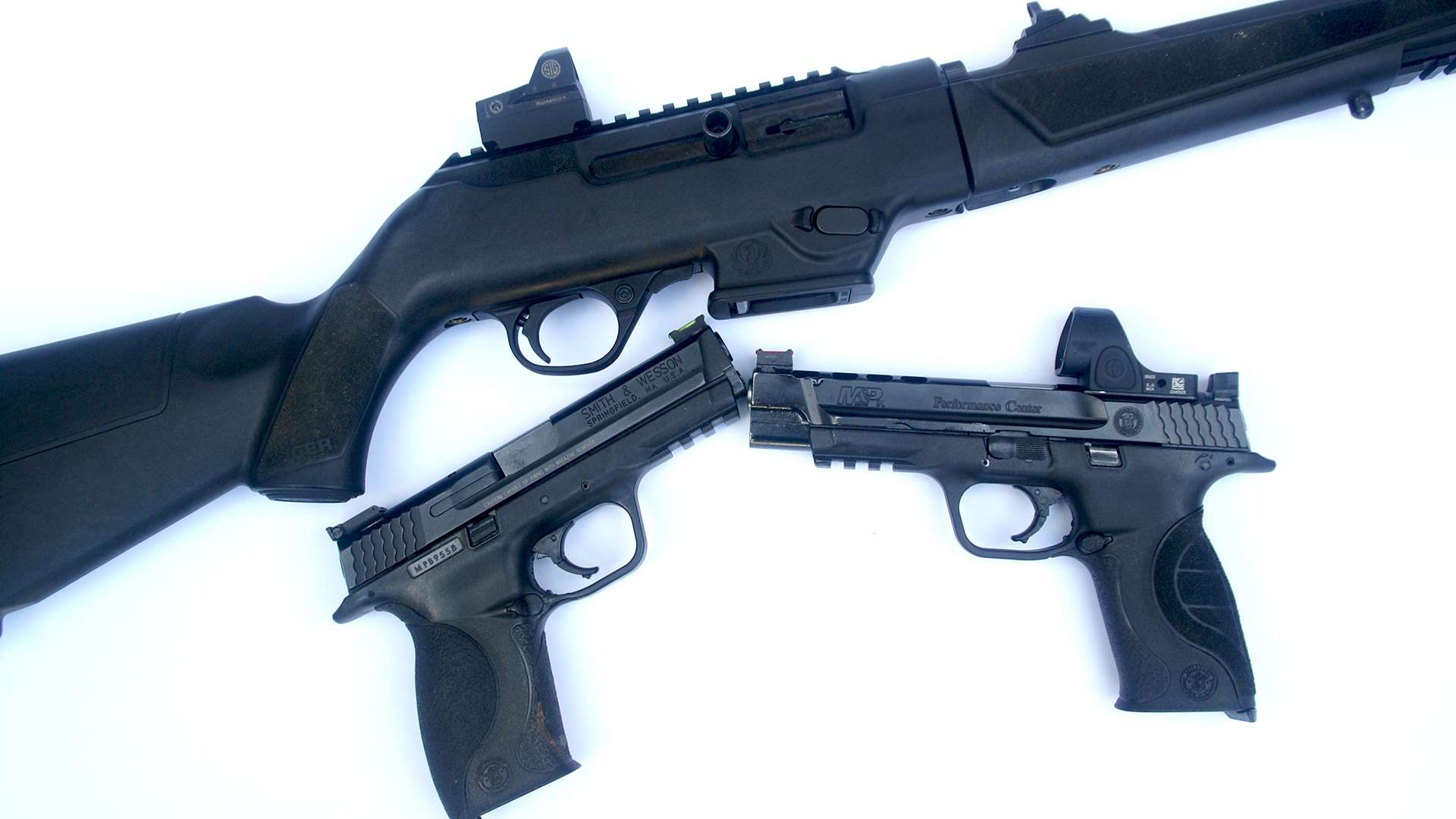
Velocities from the 4.25-inch M&P were skating right on the 125 PF line. The threeround average would have made it for USPSA, and two of the rounds did make it for IDPA, albeit barely. The increased barrel length on the C.O.R.E. boosted velocity, and all would have made it easily for either organization. With the velocity increase of a 16-inch barrel, there was no concern with the PC9, and the accompanying chart shows the figures.
Function was perfect in all three guns; there were no malfunctions. I might be a bit hesitant to take it to a major match with a short-barreled gun, given the chronograph variations. But with the more commonly used 4.75- and 5-inch pistols, and PCC—it’s a solid choice for those who acquire their match ammunition over-the-counter.
Accuracy and Chronograph Chart
Learn more at koenigshootingsports.com.
See more: WATCH: Doug Koenig Interview At SHOT Show 2020