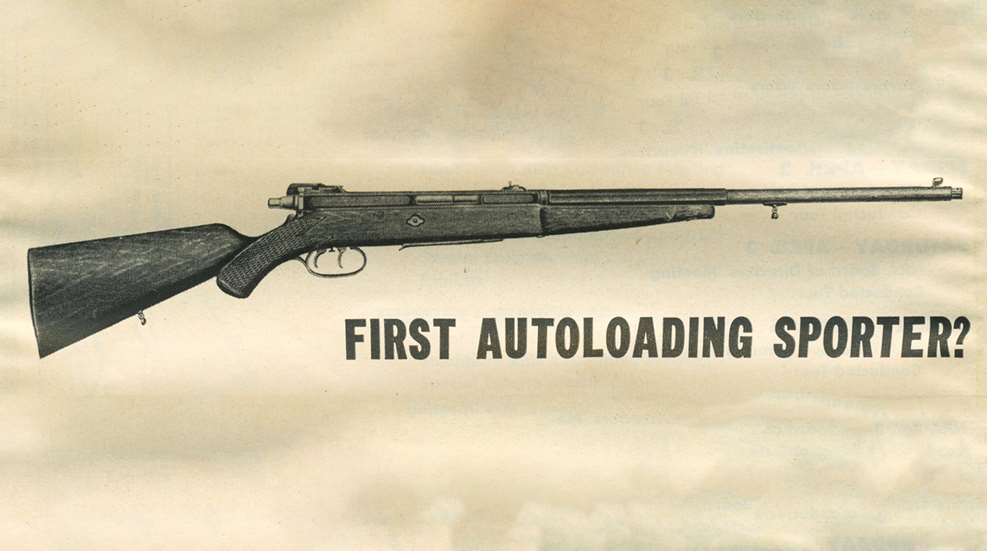
From the vault: an article from the August 1954 issue of American Rifleman about the 1899 Mannlicher Automatic Repeating Rifle by Roger Marsh.
First Autoloading Sporter?
By Roger Marsh
Recently a demonstration rifle has come into my possession that was described at the time it was issued (1899) as “the first Automatic Sporting Rifle put on the market.” Designated in the catalogue of A.W. Funke, a New York importer, as the “Mannlicher (Haenel) Automatic Repeating Rifle,” the rifle was years, even decades, ahead of its time. Design features incorporated in this 1899 arm would, if they were included in a weapon today, evoke favorable comments on the brilliance and inventive genius of the designer.
The rifle, 42⅜ inches long, is built on the G. Roth system. A long-recoil actuated locked-breech sporting autoloader, it was chambered for a special 8 mm cartridge, described in German literature as a “shortened cartridge case of the Austrian-Hungarian Army rifles with a half-jacket bullet.”
The action is the most interesting portion of this autoloading rifle.
The bolt mechanism has only three major parts—a bolt body, a bolt sleeve and a combination firing pin and locking cam. The firing pin, caught back by a bolt latch mechanism as the recoiling parts start forward, rotates the bolt body to unlock it from the barrel extension and then holds it back until the returning barrel trips the latch mechanism as it goes forward into its seat.
The bolt mechanism, thus released, goes forward to load a round and lock, the firing pin camming the bolt body. Before the firing pin can complete its forward movement to fire the cartridge, it is caught by the sear. Manual release of the sear through pressure on the trigger permits the firing pin to move forward and strike the primer. A disconnector is provided to prevent full-automatic fire.
The arm is fed form a fixed, five-round, staggered-row box magazine which is loaded through a releasable bottom-plate, somewhat in the matter of the later “Standard” rifles.
The rifle was available in single-trigger and double set-trigger versions.
The design of the Mannlicher (Haenel) repeating rifle was brilliant, the execution superb. Why the weapons did not succeed commercial is hard to understand.
Read more articles about the history of the shooting sports:
- Wright Brothers At Kitty Hawk: Hunters And Marksmen
- The First Targets At Creedmoor Were Giant Iron Slabs
- A Short History Of American Target Development And Evolution
- NRA Annual Matches Move To Sea Girt In 1892
- A Page From History: The Savage Model 1919
- Meteorology And The National Matches
- A Page From History: Maintaining Revolver Accuracy
- A Page From History: Measuring Groups
- A Page From History: BB’s And Air Guns
- Great Moments In Sportsmanship: Vere Hamer
- The History of the Mannlicher-Schoenauer Carbine
Most Popular