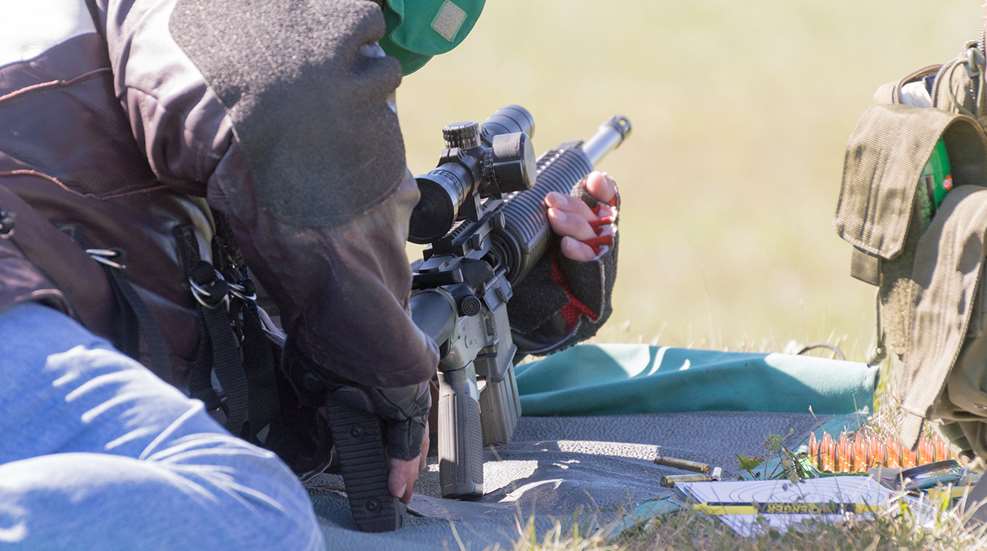
High Power Rifle Mid-Range matches are fired at 300-, 500- and 600-yard distances, and don’t require the hot cartridges that you see for dedicated 1000-yard shooting. When considering cartridges for these distances, many shooters will use the unmodified .308 Win. (Palma) or the .223 Rem.―which coincidentally won the 2018 NRA Mid-Range Nationals at Camp Atterbury. However, the .223 Rem. and .308 Win. could be at a severe disadvantage at most ranges under normal conditions. For that very reason, astute competitors should consider the myriad of other options that exist on the market.
Here’s what to look for in a cartridge that is capable of winning a mid-range match:- High quality, uniform cases.
- Small primer ignition.
- Low recoil for low shooter fatigue.
- Good ballistic efficiency.
- Good barrel life.
- Tooling costs.
With these criteria in mind, 6mm cartridges of low- to mid-powder capacity are ideal because they have been proven to work well at 1000 yards―and they work even better for mid-range events.
Thus, the first cartridge to consider for mid-range competition is the 6BR Norma with a long enough throat to shoot 105- to 107-grain bullets. This little powerhouse gives the shooter a slight edge for wind drift compared to other cartridges having taller groups that produce corner shots. The straight 6BR will also shoot inside of the .308 Win. using any projectile that you can stick in it. Barrel life in the 6BR is excellent (37 grains of water volume) and shelf tooling is reasonable.
The next cartridges worthy of consideration are the 6BRX and the 6BR Dasher. These cartridges require forming, however the forming loads will shoot just as well. Based on the 6BR, these two cartridges yield 100-150 fps additional velocity over the straight 6BR using the 105- to 107-grain bullets. The other desirable attribute of 6BR that is maintained is very low ES/SD numbers. Their case capacities of 41 grains of water volume gives just enough case increase that a person could consider using the Sierra 100-grain Match bullet or the 110-grain made by Berger. These bullets really won’t cut it in the straight 6BR because of the law of diminishing returns. However, the 100-150 fps higher velocity comes at the cost of barrel life. Ranges of 1,700 to 2,000 rounds on a cut-rifled barrel are very normal. Additionally, the tooling costs on these 6BR variants will be higher, so be advised.
This next group of cartridges have higher water capacity by volume (noted in parentheses) and have the ability to drive the heavier weight bullets of 110-115 grains should the need arise. These include the 6x47L (45) and the 6XC (48). All have very high-quality brass available that utilize the small primer pocket. Factory-made tooling is available for these, but none of the dies can be considered “standard.” Barrel life can be extended on these to be comparable to the larger 6BR variants by using powders that do not impact so much heat into the throat area. A rule of thumb is approximately 1,700 to 2,000 rounds as a maximum on cut-rifled barrels.
Something to note: The 6-250 (48) and the 240NM (48) should be included in this group, but they do not have small primer brass available. Regardless, they will shoot just fine for 300- to 600-yard events.
The next two cartridges to consider are the 6mm Creedmoor and the .243 Win. Case volumes of water on these are 50 and 54 grains, respectively. The newer 6mm Creedmoor is starting to gain traction at mid-range events, since high-quality cases using the small primers are now available. Barrel life with this new cartridge is currently up in the air, but my guess is that 1,500 shots is doable with the right powders. As a dedicated mid-range and long-range cartridge, 6mm Creedmoor will be one of the better ones if shorter barrel life isn’t a concern.
Regarding the .243 Win., everyone that has been paying attention to long-range shooting has seen proof of how this cartridge has performed. If you can find an exceptional lot of primers to make it work, the .243 Win. can get the job done. But, I would advise against it for mid-range. The recoil factor, ballistic uniformity and barrel life for shooting 300- to 600-yard matches yields to just about any of the other options listed here.
Overall, there are a lot of good options available in order to be successful in mid-range competitions. But one thing is certain―I’ve had previous success with 6mm calibers, and would definitely pick one again if given the choice.Continued Reading: