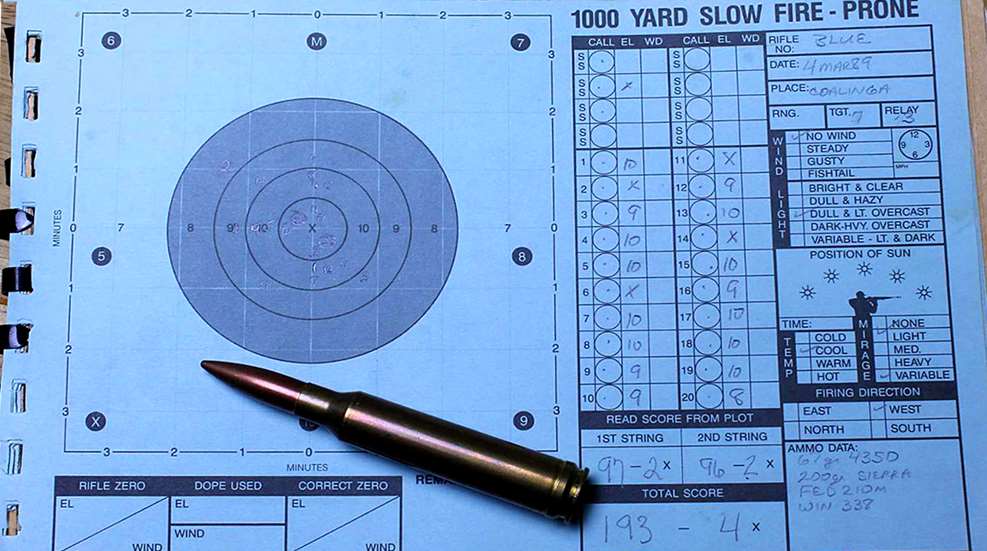
Above: The author's nearly 30 year-old data book shows the .30-338 competitive at 1,000 yards with 200-grain bullets while the Navy struggled to make the .300 Win. Mag. shoot 180-grainers.
The June 2017 American Rifleman includes a well-researched article by Aaron Carter on the military perspective of evolving the .300 Winchester Magnum into the Mk 248 MOD 1 cartridge used by American snipers today.
The article includes an interesting statement that the U.S. Navy Match Rifle Team back in 1988 found the 180-grain Sierra MatchKing (SMK) bullet in the .300 Win. Mag. going subsonic and “keyholing” at 800 yards. That prompted me to dig out my old data book from my days on the Navy’s Pt. Mugu rifle competition team from 1988-1990, to confirm my recollection that my load then for the .30-338 Magnum rifle I called “Big Blue” was a 200-grain SMK, 67-grains of IMR 4350 and Federal 210M primer on a necked-down Winchester .338 Win. case. “Big Blue” never keyholed at 1,000 yards and I recorded 20-round match scores in the 190s.
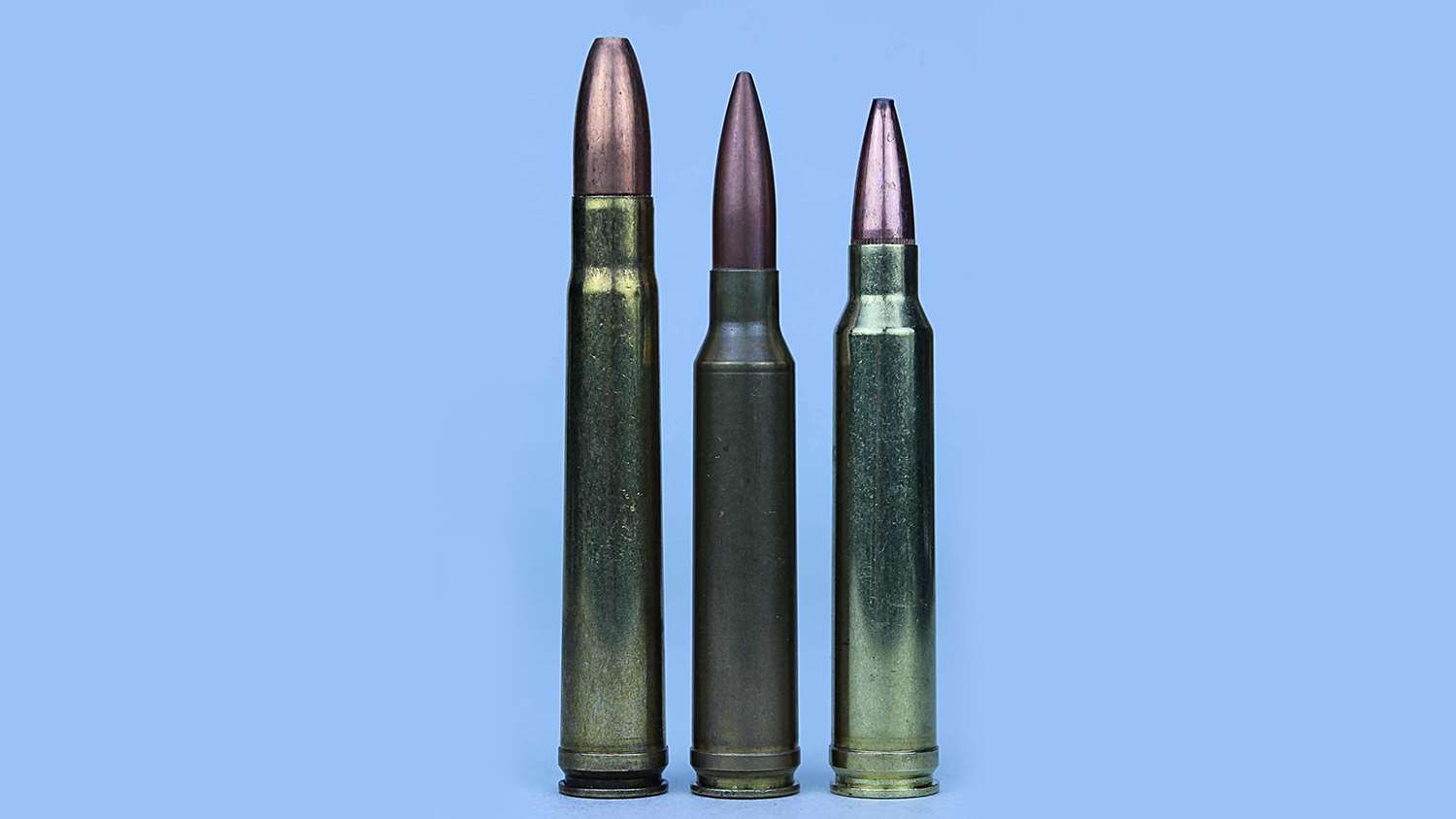
What’s that got to do with the .300 Win. Mag.? The .300 Win. Mag. was the darling of Long-Range competition for a while, but before Winchester introduced it in 1963, competitors were already shooting it as the .338 Winchester necked down to .30 caliber, the .30-338 Magnum. Introduced by Winchester in 1958 as a shortened and blown-out (to remove the case taper and increase volume) .375 H&H Magnum case with a .338 bullet, Roy Huntington receives credit for being the first to reduce the .338 Win. Mag. neck to take a .308 bullet that very same year. Five years later Winchester introduced their .300 Win. Mag., essentially the same cartridge with a shoulder slightly further forward and a shorter neck.
Going heavy
I believe there were a few Leech and Wimbledon Cups awarded at the Nationals to competitors shooting 190-grain SMKs in the .30-338, and it’s pretty doubtful those bullets were keyholing at 1,000 yards. And, as I mentioned, I did alright with heavier 200-grain SMKs in the .30-338. So, you’d think the .300 Win. Mag. could keep a 180-grain bullet supersonic past 800 yards if the .30-338 could do so with heavier bullets. What gives?
According to Hornady’s online ballistics calculator, a 180-grain SMK started at 2900 fps is still supersonic at 800 and even—just barely—at 1,000 yards (1558 fps and 1316 fps, respectively). The 190-grain and 200-grain SMKs have a higher ballistic coefficient, the latter maintaining 1505 fps at 1,000 yards when started at 2900 fps. But for whatever reason, the Navy struggled with the lighter 180-grain bullet intended for sniping with the .300 Win. Mag. when Long-Range shooters were already enjoying success with heavier bullets in essentially the same case. Perhaps someone who was there can tell us why the 180-grainer failed for the Navy at that time.
I did have a similar failure with 180-grain SMKs at 1,000 yards, but that was when I dabbled with loading them for the M14 National Match rifle that I also shot with the team. I attributed that keyholing problem to a lack of finding the right powder that would fit the 7.62x51 NATO case and required OAL to deliver adequate long-range velocity without bashing the M14 gas system too hard. I never finished that adventure because when the station armorer found out that I was handloading for “his” National Match rifle he (pun alert!) went ballistic. I had to return to shooting only issue Lake City Match and Special Ball in the M14.
By 1993, the Navy finally did go with a 190-grain bullet in the .300 Win. Mag. Mk 248 MOD 0 sniper load, subsequently replaced by the even heavier 220-grain SMK in today’s Mk 248 MOD 1 cartridge. Both the .30-338 and .300 Win. Mag. have long fallen out of favor in competition, relinquishing center stage to the lanky 6.5x284 and then to svelte young starlets like the 6mm and 6.5mm Creedmoor.
.30-338 redux
I did load and shoot the .30-338 one more time a few years ago, a wood-stocked match rifle with Redfield Palma sights on a Model 70 action built and used by a friend who had died of cancer. I still have the set of standard RCBS dies I was using back in the late 1980s for competition, so I just made up enough cartridges of the same load on the same brass I’d used years before, got a zero at my club’s 200-yard range and showed up at the 1,000-yard line at a regional match with Glen’s old rifle and some best-guess sight dope. As expected, my scores were no hazard to the real competitors, but that’s okay. Yes, the goal in competition is to win, but we often forget that the purpose behind competing is far more important.
Today, there’s no practical reason to choose a .30-338 over a .300 Win. Mag. for competition or hunting, and every reason to go with the latter, including availability of factory rifles and ammunition. However, if you do happen upon a screamin’ good deal on a nice used .30-338, don’t pass it up. The .30-338 is in a kind of limbo, having never been factory produced—but still popular enough with handloaders, big game hunters, the nostalgic and curious that it refuses to disappear. Perusing online forums turned up more than one discussion beginning with, “I found this rifle in .30-338—does anyone know any handloads?”
.30-338 reload
First note that cartridge outside dimensions are not identical, and the .300 Win. Mag. should not fit in a .30-338 chamber. Head, rim, neck and shoulder diameters are the same, but the .300 Win. Mag., as mentioned previously, is longer in the shoulder and shorter in the neck. Based on nominal measurements alone, the .30-338 can fit into the .300 Win. Mag. chamber as both cartridges headspace on the belt, but not vice-versa.
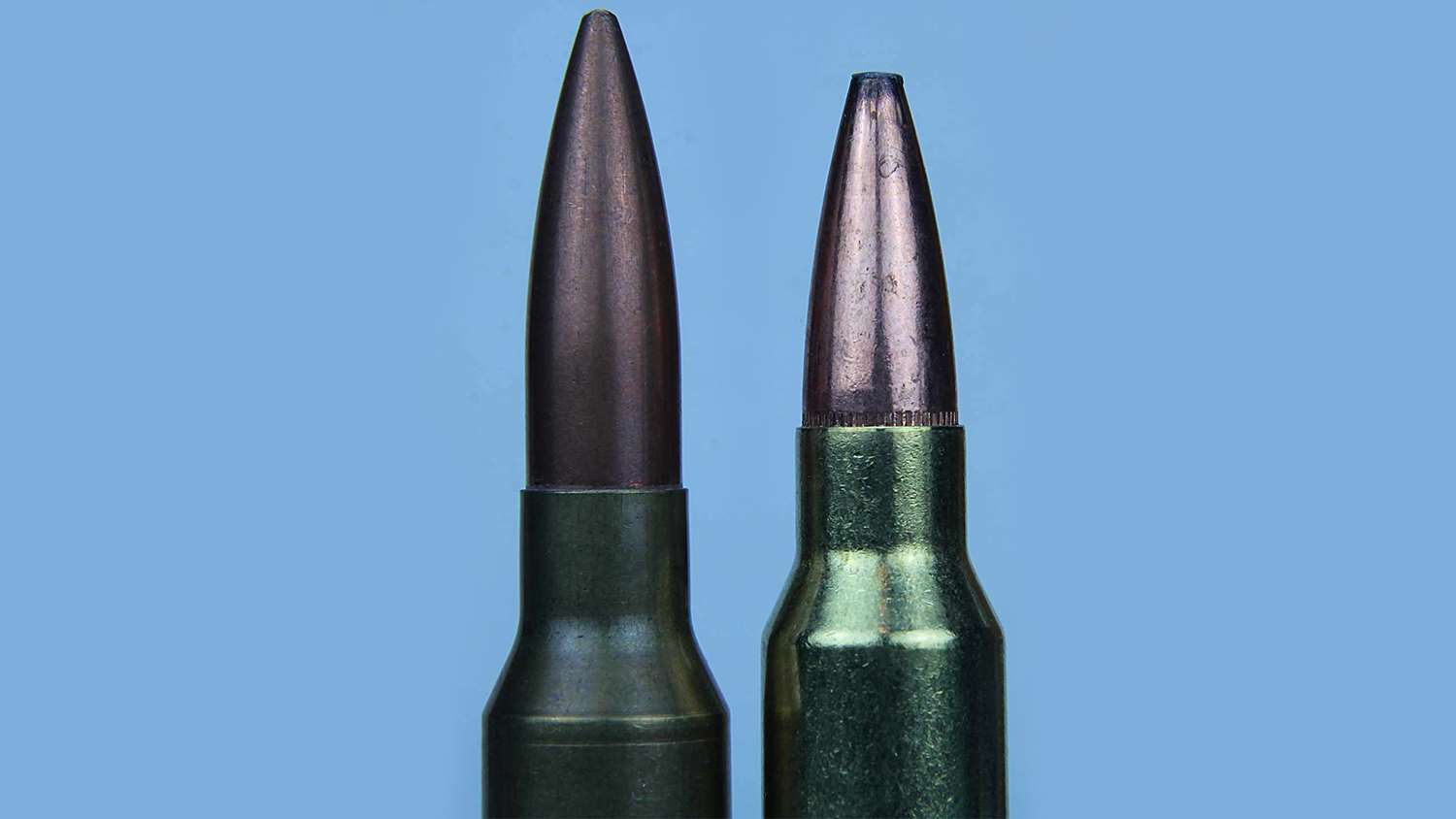
SAAMI doesn’t have a standard for the .30-338 as it never caught on with the major commercial shooting industry players, so cartridge and chambers dimensions can vary somewhat gun to gun. In comparing SAAMI .300 Win. Mag. cartridge dimensions with those for the .30-338 found in John J. Donnelly’s Handloader’s Manual of Cartridge Conversions, we find they have the same case length of 2.620-inches (though case OAL of the dummy round I saved from loading for “Big Blue” measures only 2.478-inches as a result of that lack of standardization—see above photos). However, the length from base to shoulder differs, with the .300 Win. Mag. longer by .174-inch. The .300 Win. Mag. shoulder is further forward than that of the .30-338, so the neck of the .300 Win. Mag. is necessarily .035-inch shorter, according to Donnelly.
Those slight differences call for a sizing die specific to the .30-338, so if you’re buying the rifle, the seller, if he’s been shooting it, has the dies and you’re wise to include them in the deal. Expensive custom match grade dies aren’t really necessary, but the .30-338 is considered a wildcat and you’re unlikely to find them on a gun shop shelf. If you also got the brass previously fired in the rifle as part of the deal (go you for pressing a hard bargain), you could get away with neck sizing only, utilizing a common .30 caliber neck sizing die. A .300 Win. Mag. bullet seating die should work, but if you’re not getting enough crimp (I soft-seated my bullets for competition and never tried crimping them) a .300 Win. Mag. Lee Factory Crimp Die may satisfy.
Competitors pointed to the theoretical advantages of the .30-338’s longer neck: it allows more “grip” area on shorter/lighter bullet shanks for more assured tension and concentricity, and longer/heavier bullets don’t protrude as far into the case to take up case volume. However, the latter advantage is already offset by the .30-338’s lesser volume compared to the .300 Win. Mag., and the former is dependent also upon chamber and seating die dimensions. Touché.
The .300 Win. Mag. has slightly more volume than the .30-338, a function of Winchester moving the shoulder forward and shortening its neck. According to Donnelly, the .30-338 holds about 6-grains less water than the .300 Win. Mag., indicating lesser volume and (according to Boyle’s Law) somewhat higher pressure than the .300 Win. Mag. given an identical load. Load data for the .300 Win. Mag. abounds and is usable when reduced five to 10 percent for the .30-338, and .308 Norma Magnum data is pretty much a straight match-up, but it’s a good idea to approach stouter loads with greater caution. My old 67-grain load, in fact, is a .300 Win. Mag. maximum in Sierra’s 5th edition loading manual. I recall that cases didn’t suffer from overstretching at the belt/web, but after a half-dozen reloadings I was tossing out an occasional case for neck cracks.
Shot-out winner
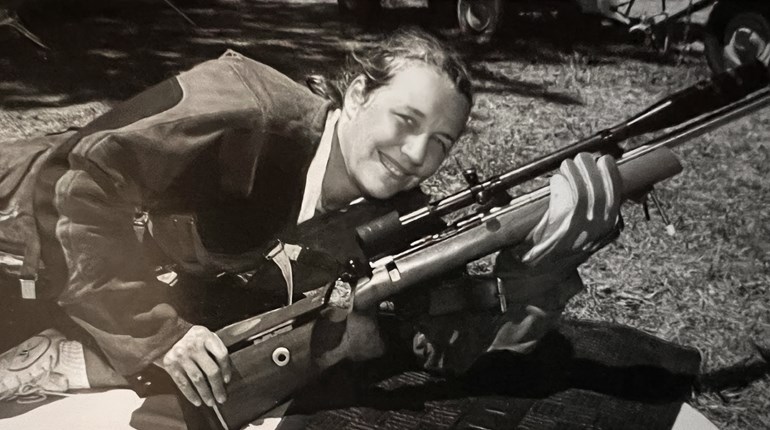
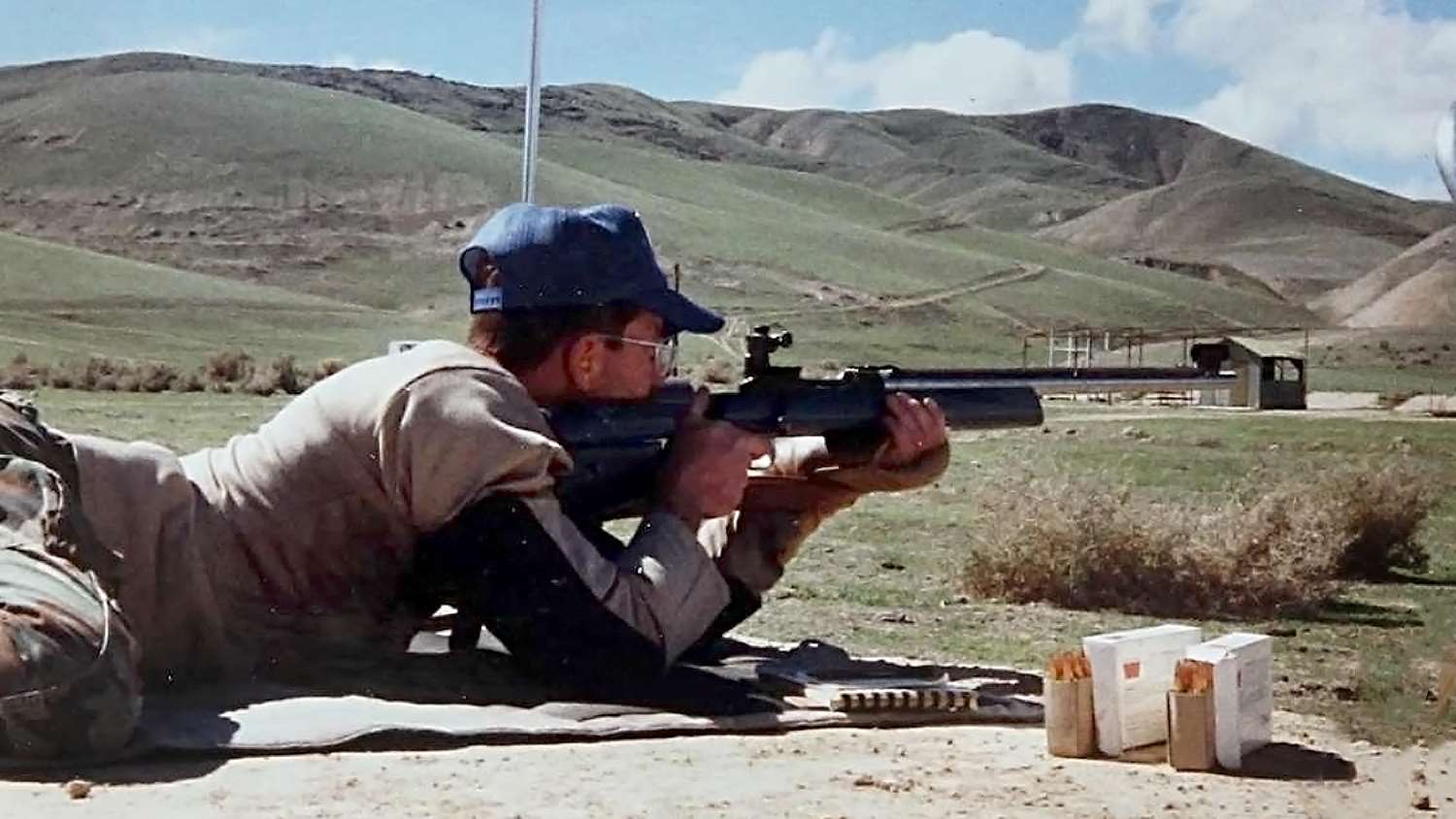
I was fairly new to handloading and new to competition at the time of that 1989 data book entry I mentioned at the beginning, and no one else on the team wanted to buy dies to handload for and shoot “the bolt gun”—a .30-338 Winchester Model 70 on a blue synthetic stock built by Naval Surface Warfare Center-Crane, serial number 383132—“Big Blue.”
I recall once setting up at an NRA Long-Range match at Camp Pendleton, when some older civilian gentlemen were asking me about “Big Blue” and my handloads; as we chatted, a Navy lieutenant walking past, captain of another team, heard me and paused.
“Is that rifle in .30-338?” he asked.
“Yes, sir,” I replied.
“Those are all shot out,” he said curtly before stalking away, “you’re supposed to turn that in.”
After a moment of embarrassed silence the other gentlemen drifted off. But “Big Blue” and I got the last word at the match awards ceremony after we won in our classification. The lieutenant’s team firing Remington 700s in .300 Win. Mag. was nowhere in sight, having already packed up and left without reason to hang around, if you get my drift. Maybe they were shooting 180-grain bullets.
Most Popular