
“There should be no doubt in anyone’s mind after this year’s record-setting performances that the M16 rifle is now the dominant service rifle on the range.”
—Chief of Competitions D.I. Boyd in a USAMU press release
The 1995 National Match program was directed by NRA National Match Coordinator M.S. Gilchrist and Executive Officer Michael Robertson of the DCM, both of whom brought a wealth of knowledge and experience at a time when the event neared a critical turning point in its much challenged and scrutinized history.
Gilchrist, a decorated 26-year Army veteran, served as DCM Director from 1986 through 1990—one of the longer tenures for the position—and began working for the NRA in 1991. His familiarity with the National Match structure made for a smooth transition when he became NRA Coordinator for the matches. “I essentially knew what was going on,” Gilchrist recalled. Indeed, this year marked the end of a period where attendance had declined by more than 1,000 since the start of the decade. (Participation figures neared 5,000 in 1990 vs. just over 3,200 in 1994. This year’s numbers were slightly higher than 1994.)
Gilchrist’s last year as DCM Director (1990) was also the last time James Lenardson competed at the National Matches and won his second national pistol championship. This year Lenardson returned, five years removed from Camp Perry and the Air National Guard, and worked his way back to the winner’s podium with a combination of skill and good fortune. It was a rare civilian win in a competition usually won by service shooters. (The last civilian to win the national pistol title was Max Barrington in 1985, shortly after his retirement from the Army.)
With the exception of 1990, when Lenardson won the title with a reduced score due to the cancellation of the .45 matches, his score this year (2639) was the lowest since 1987. Record high temperatures may have played a part in the lower than average scoring, as all three championship aggregates were won with scores in the low 880s, but Lenardson managed to stay in the hunt with a pair of 879s, which left him five off the pace and third overall going into the .45 stage. Once there he shot a modest score (881) with his five-inch barreled Colt, but it proved to be more than enough to leapfrog over Master Sgt. Darius Young and Ricardo Rodriquez, who shot sub-par scores of 871 and 868, respectively. In the end, Lenardson had the five-point lead and the championship as Young registered his third consecutive second-place finish with a 2634 total.
Ruby Fox swept the women’s aggregates for a second straight year, defended her title and claimed her 12th national crown in the process while the junior and senior winners were also successful title defenders as John Bickar and Ed Williams topped their respective categories. Ronald Zalewski, who won the National Trophy Individual (NTI) Match in 1991, topped the President’s Match field this year, Staff Sgt. Patrick Powell of the Army National Guard earned NTI honors and USMC Scarlet defended its National Trophy Team title.
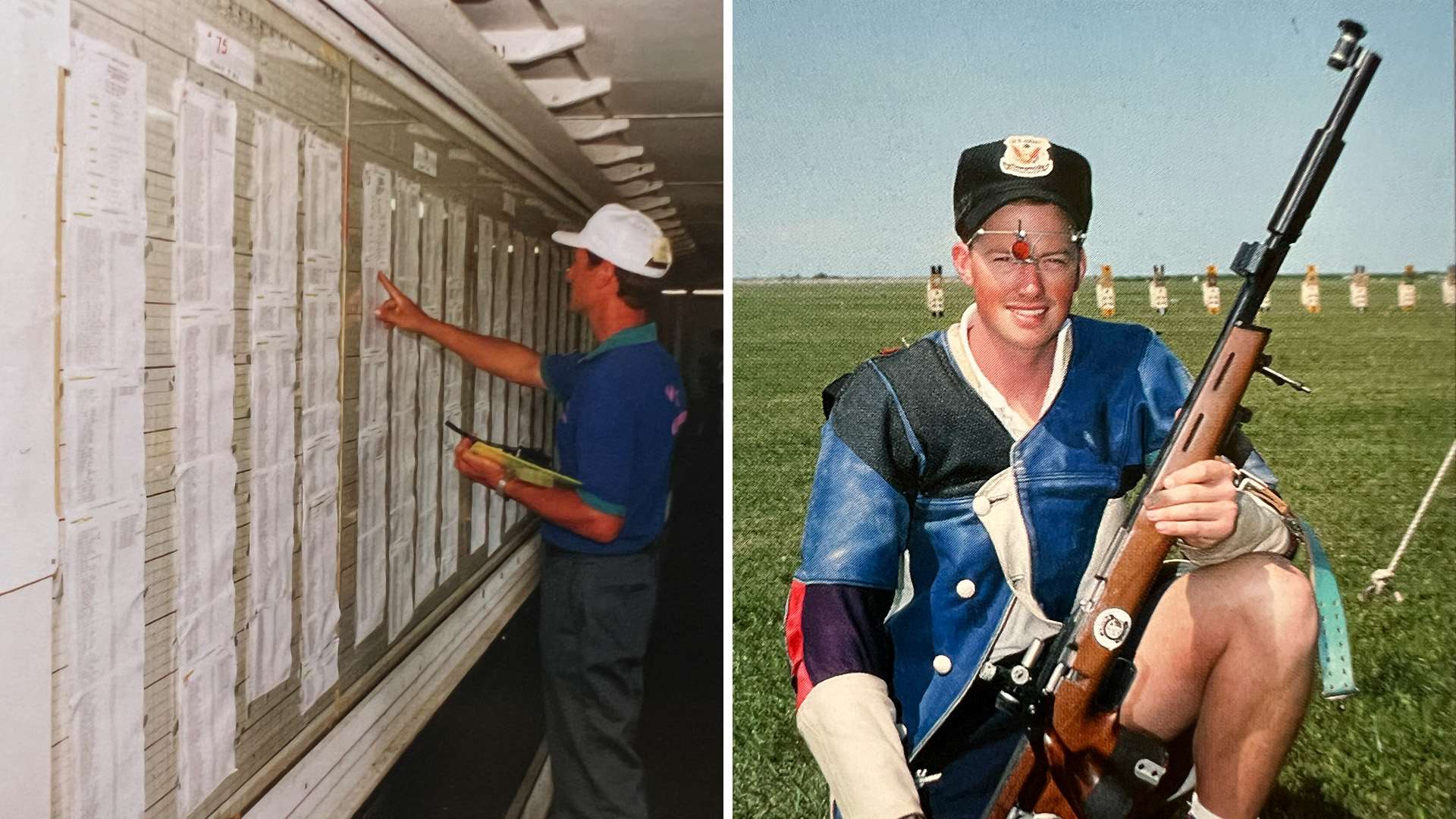
Corp. Ken Johnson of the U.S. Army Marksmanship Unit at Fort Benning left Camp Perry in 1994 after topping his second place finish in the three-position championship with the national prone title five days later. After a year’s time, he returned as driven as ever. Although his performance from match to match was not spectacular, it was marked by a consistent production of quality scores.
Johnson’s teammates, Capts. Matt Suggs and Glenn Dubis, took the prone and standing matches, respectively, before civilian Ken Benyo closed out the metallic stage with a kneeling win. Sgt. Tom Tamas, who had already won a national three-position title back in 1989, won the 1995 metallic sight championship with an 1146 and seemed poised to go after another title when, on scope day, he widened the gap a bit with an opening prone win. Johnson was four off the pace at the halfway mark and finished right behind Tamas in prone. During the standing match, all the leaders were blown away when Capt. Web Wright, III, pushed the national record up by two points to a 377 and again, Johnson stayed within reach at 374.
The deciding match, kneeling, proved to be an all-AMU final as Capt. Steve Goff, Lt. Gary Hardy and Johnson all tied up at 385. Goff’s 17 Xs gave him the win, but the other two each had 15 Xs and it took a long look at the rulebook to place Hardy second and Johnson third. Hardy erased the year-old any-sight championship record with his 1157-43X but was eclipsed by Johnson who tallied six more Xs.
When both scores were added, Johnson had won his first national position championship and Frank Parsons Trophy along with the service crown. Benyo was the civilian champ for the third straight year while Jean Foster earned her first Mary C. Camp Trophy for the women’s title. Herb Pasch achieved the near impossible when he dethroned Fred Cole from the senior perch he held for seven years and college senior Cory Brunetti took back the collegiate trophy he last held as a freshman.
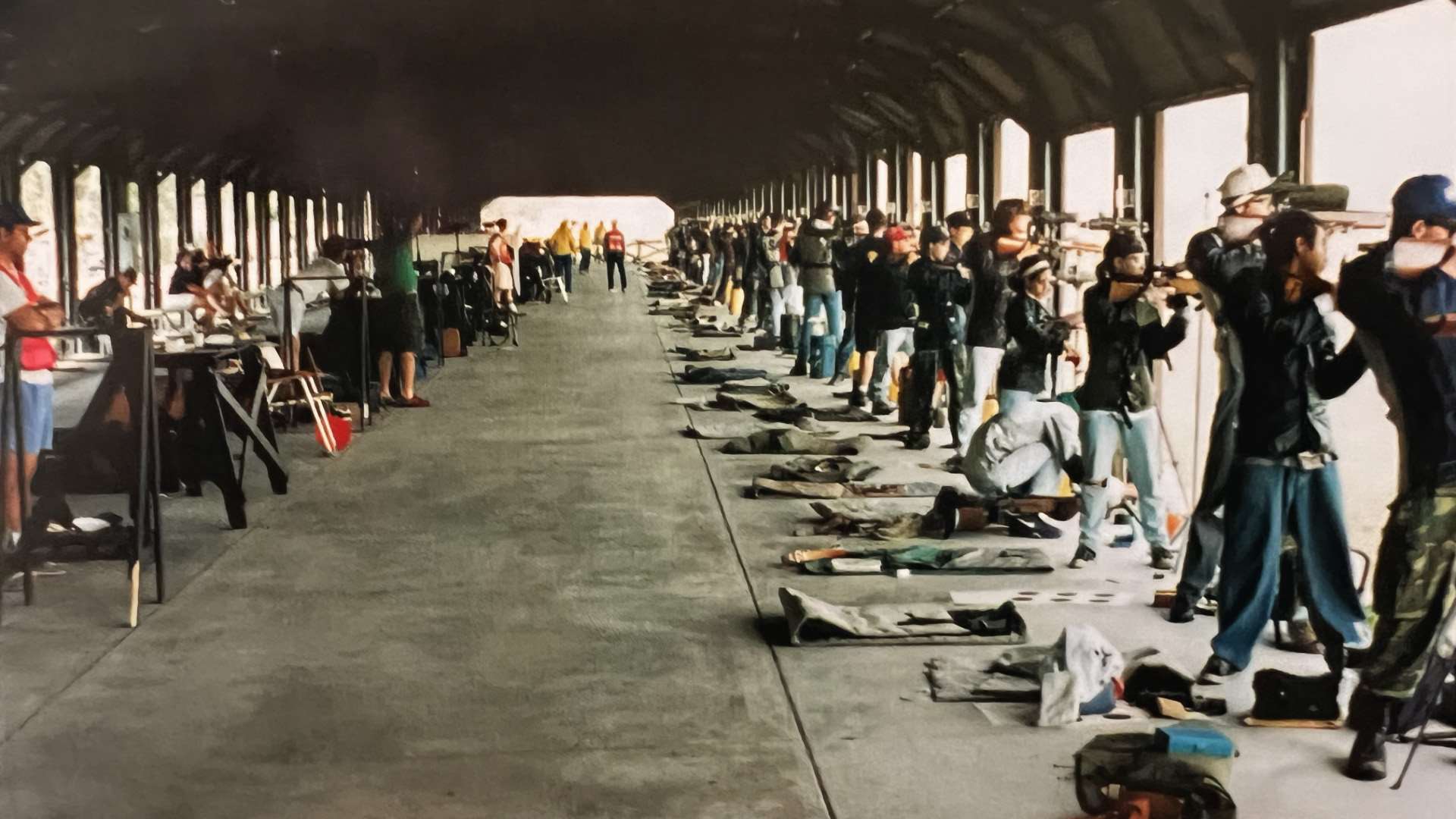
The sweltering heat that had been present since the pistol phase continued right through the position matches and on into prone. Defending champ Johnson, though hot off his position win, was counted out of the prone running by those who believed in the superstition that since he had won the Sydney (Ohio) Regional the week before, he was ensured a poor showing at Perry.
The wind did act up at first and valuable points were lost. Tamas began the day with a 400-33X and the Dewar win and Suggs followed with the only 400 at 100 yards. After day one, Army Reservist Sue Mitchell held a one-X lead with her 1597-105X. Johnson entered day two 11 points down, but an early match win in the Dewar followed by a one-X second place finish at 100 yards seemed to have him back on track. The second day ended with 1600s by Suggs, Wright and Tamas and the metallic sight championship went to Suggs and his 3194-263X.
The heat continued through team day and into the last two days of the prone championship where, just as he did on day one, Tamas got out of the starting blocks quickly and notched a Dewar win. After back-to-back wins by Brunetti, Tamas closed the day with another match win for his second consecutive perfect score, winning the daily aggregate with a 144 X-count.
With 160 shots remaining the field was tight. The last four match wins went to Suggs, Carolyn Millard-Sparks, Sgt. Lance Hopper and Randy Schwartz, but Tamas had built up a 3200-280X to add to his metallic sight score. He won the any sight championship by a 14 Xs over Ron West while Johnson took third at 3199-257X.
Tamas had dropped all seven of his points on the first day and then ran 480 10s and Xs to win the national championship and service title. Suggs and Wright filled out the top three for an all-Army show. T.R. Bishop took civilian honors and fellow North Carolinian Edie Reynolds topped the women’s field. Ron West and Lones Wigger, Jr., repeated as senior and intermediate senior winners while Brunetti doubled up championships when he added the prone collegiate title to his position victory.
Johnson and Tamas made the 1995 smallbore matches memorable. Young shooters with great potential, they both demonstrated all the traits of champions and role models.
Many stories emerged from this year’s high power phase of the National Matches—a strong M16 presence by the Army, record scores, a national title defense, 1,000-yard victories by husband and wife, Nancy Tompkins-Gallagher and Middleton Tompkins in the Leech and Wimbledon respectively, and it began with the first event fired, the National Trophy President’s 100 Match.
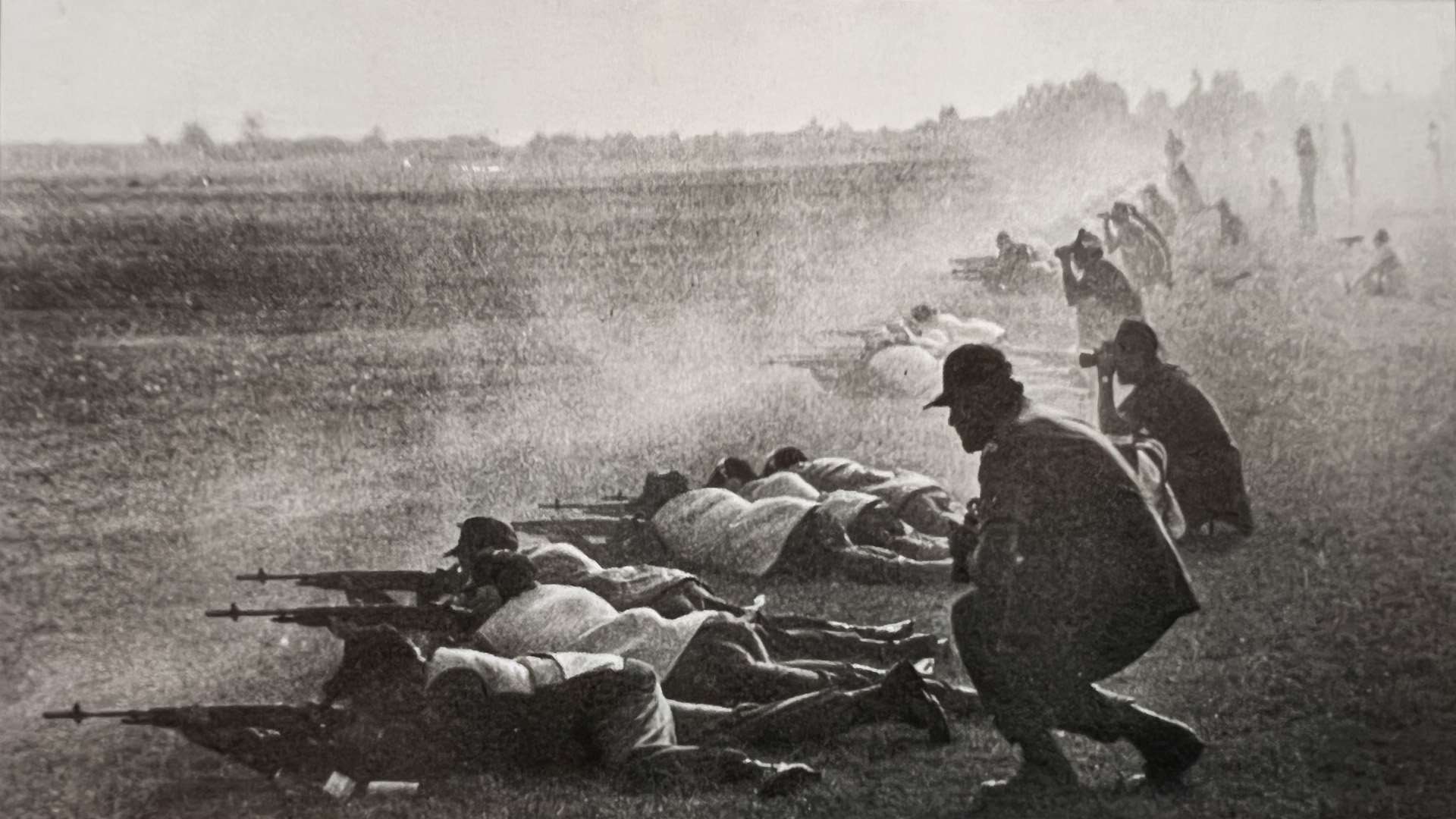
Army Sgt. 1st Class John Chubb turned heads when he fired a record score (298-12X) with an M16 to top the 1995 President’s 100 field. Three days later his teammates laid down a record score with M16s in the National Trophy Team Match, the first National Trophy win for the Army in 11 years. And not to be outdone, when the National Trophy Infantry Match “Rattle Battle” was complete, the top two scores, both by Army teams, had surpassed the previous high score. Marine Sgt. Alexander Arrieta, who fired on the runner up team for the National Trophy, prevented an Army sweep when he won the National Trophy Individual Match.
Once the NRA championship got underway, the Army continued its show of force as Specialist Tobie Tomlinson, part of the winning Rattle Battle contingent, won the service title with an M16 and a 2360 score. Defending national champ Mitchell Maxberry ran into some misfortune, such as miscounting his shots on a rapid-fire stage that cost him points, but he managed to stay close, garnered one of the three championship aggregates (Nevada) and won his second national title with a 2374-110X. He even reloaded in his room at night when he realized the new barrel on his Remington 700 wasn’t completely broken in. His resourcefulness and ability to stay focused paid off as he became the eighth shooter in National Match history to produce back-to-back high power titles. (The others were Loyd Crow, Mid Tompkins, Ronald Troyer, Gary Anderson, Carl Bernosky, Pat McCann, and G. David Tubb.)
Maxberry’s Palma teammates Gary Rasmussen and Tom Whitaker won the other two championship aggregates and it was Whitaker who finished second to Maxberry by three points while Rasmussen was named national police champion with his 2363 performance. Don Bartlett topped the senior class while Paul Reynolds earned the junior title.
Maxberry earned another notation in the National Match records when he won this year’s Tompkins Trophy, emblematic of the NRA National Long-Range Championship. For Maxberry, it was his third championship overall, but the fact that he won it in the same year as his high power title put him in exclusive company. Until this year, only G. David Tubb had accomplished the feat (in 1988).
1995 National Matches Fact
This year muzzleloading competition at the National Matches was elevated to championship status when the NRA presented the National Muzzleloading Rifle and Pistol Championships along with the Camp Perry Muzzleloading Matches. Muzzleloading first entered the National Match picture on an informal basis back in the 1920s while the first official organized competition took place in 1953 when the National Matches returned to Camp Perry after World War II.