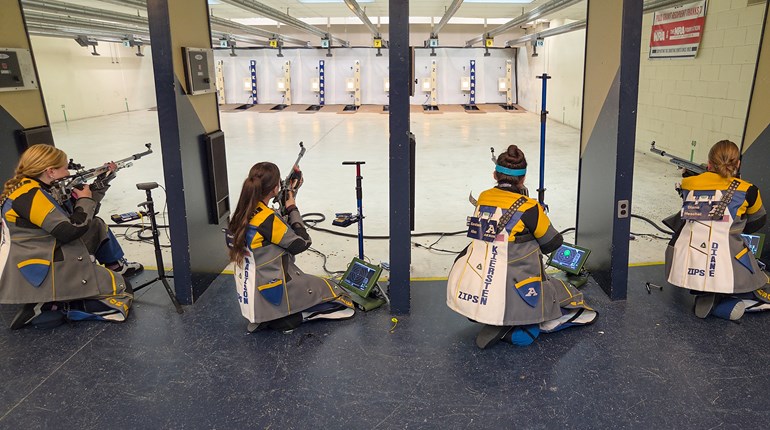

I want to start off by saying I know many people have an opinion on this issue, since ranges everywhere are deciding whether or not to switch over to electronic targets. I myself had reservations when my school changed over. However, I came to love them and I’ll tell you why.
I first encountered electronic targets my sophomore year at Virginia Military Institute (VMI). Our rifle team was traveling to the Naval Academy which had electronic targets, but I was used to shooting on paper because that was all our range had. I remember my captain telling me that my score would actually go up because I only had to shoot at one target instead of 10. Also, I wouldn’t have to break position by bringing my targets back and forth on the line.
Unfortunately, my scores didn’t improve—but there was an obvious reason. I wasn’t used to practicing on electronic targets. So why would I miraculously score better on something I wasn’t used to? Yet, that didn’t make me dislike them.
The following year VMI installed electronic targets on half of the shooting range, and in my opinion it was absolutely the best decision ever. Instead of wasting time sending paper targets back and forth on the line and breaking position, I was able to spend more time actually practicing and keeping a solid position until I was finished with my line of fire. The electronic targets definitely helped our team improve and because of that, a few months later they were installed on the other half of the range. Our range finally reached the 21st century—and I couldn’t have been happier.
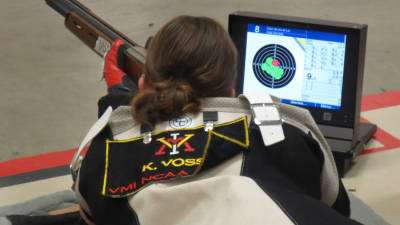
Because of this, I looked forward to going to practice—more so than when we had to shoot on paper. I loved the discipline it took and the precision of it all. It brought me peace and stress relief as I donned my shooting attire and got in the prone position. I had one target I had to look at shot after shot. I no longer had to constantly move my body or anything for that matter just to center in on another target. Thus, I didn’t move because I knew if I moved I wouldn’t get consecutive 10’s. Once I found that sweet spot, there was no moving until I finished my 20 shots. I was in my rhythm, knowing when my heart was going to beat and the exact time I needed to pull the trigger. I found my bread and butter. The same went for air rifle as well. Once I found my sweet spot in standing, I did not move my feet for the death of me until I had completed my 60 shots.
Another plus for electronic targets is you don’t have to score your own targets. I dreaded scoring my own paper targets, partly because I was never very good at it. After the electronic targets were installed at the VMI range, I had instant feedback for every single shot and could adjust accordingly, especially since I could take as many practice shots as I wanted in the time allotted and the screen was right beside me to show me where I had hit.
Despite this, you have to keep in mind that there will always be cons. Nothing is perfect, but you can work with what you have. For instance, due to the instant feedback, you are going to want to look at the screen immediately to see what you scored—DON’T. You still need to wait at least three seconds after you break the shot to make sure you follow through. Otherwise, you won’t improve your scores at all. Additionally, you always need to practice how you compete. So unfortunately if you will be traveling to a range that you know has paper targets, then you need to somehow practice on paper targets. I’m not just preaching to the choir on this, because I actually practice what I preach.
The last match of my collegiate rifle career was sadly on paper targets, but I suppose it was only fitting since I started my rifle career on paper as a freshman and ended it on paper at my championship match as a senior. So in order to prepare, our coach set up paper targets for us to practice on. To my dismay, they didn’t do me much good and I ended my rifle career far from where I had hoped to end it. Nevertheless, my collegiate rifle experience was more than I could ask for.
All the same though, I stand firmly in favor of electronic targets and hope that eventually all ranges will switch over. Everyone wants to see that magical 10.9* appear on the screen. Once you do—you will never look back.
Readers should also check out Kristen Voss's tips on becoming a collegiate rifle shooter.
Most Popular