** When you buy products through the links on our site, we may earn a commission that supports NRA's mission to protect, preserve and defend the Second Amendment. **
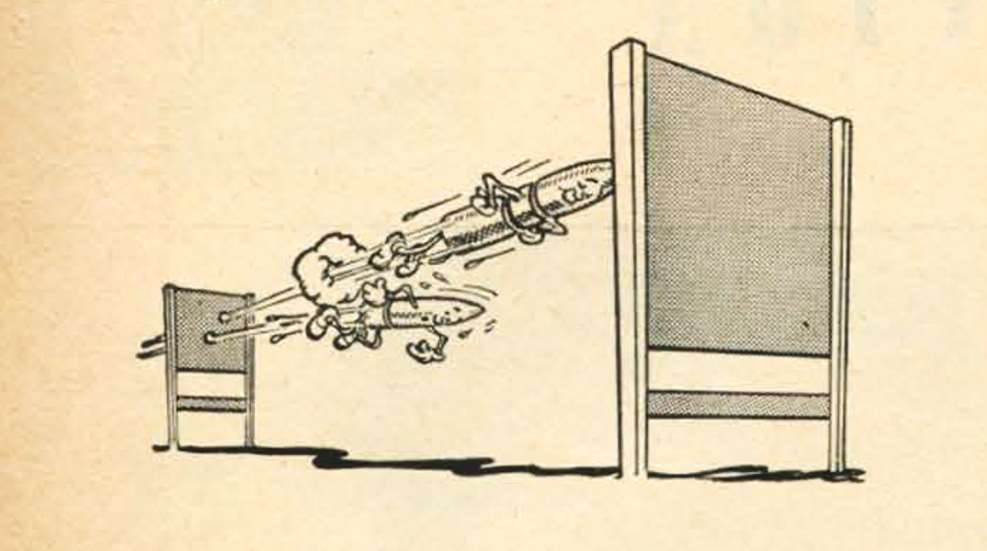
From the September 1951 issue of American Rifleman, an excerpt from an article by Robert Hutton on rifling twist and bullet flight.
Three years ago, with the help of some thirty shooters who were participating in the development of a modern cartridge, the writer began a series of tests to see what wildcat cartridges would do as regards to accuracy and trajectory. Theses tests, now complete and reported upon in the American Rifleman in .25-caliber (November 1949) and in .30-caliber (March 1951), show that all of the wildcats selected for the tests delivered faster velocities and better accuracy than any standard cases.
All of the shooting was in the form of drop shooting after each load had been zeroed at 100 yards. When possible, velocities were choreographed. We do not know pressures.
What we did not know when tests were started was that barrel twist made any great difference. It was presumed that the chap who designed a cartridge knew also what twist barrel his cartridge would require, and if he stayed strictly with the Greenhill formula* that is where it seems he may have been sadly mistaken.
Sir Alfred George Greenhill (1847-1927), English mathematician, who worked out the accepted formula for determining twist of rifling, was a lecturer in mathematics at Emmanuel College, Cambridge, 1873-76, and a professor of mathematics to the advanced class of Artillery Officers, Woolwich, from 1876-1906.
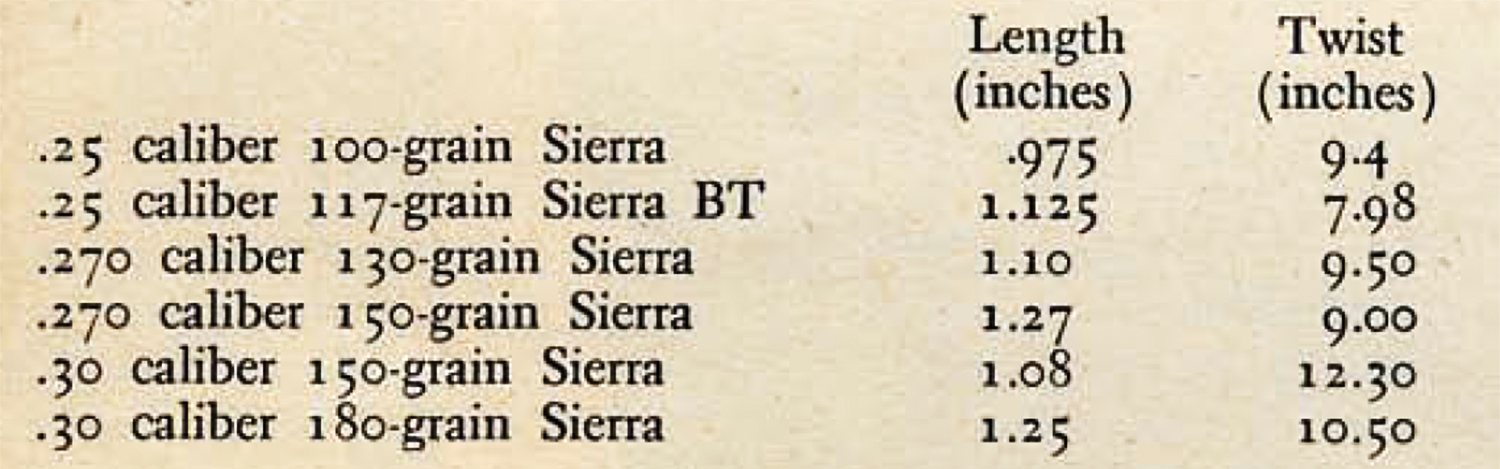
The Greenhill formula, which states categorically the twist a rifle barrel should have, has been accepted as the standard authority by factories, individual designers, and careful bandleaders since the middle of the 19th century. Translated by Al Barr the application of the Greenhill formula to modern bullets is as follows:
What we learned through these tests was that the formula for determining twist is not always reliable. To know a rifle and cartridge, it is necessary to study the bullet in flight with specific reference to how and when and even why it hits the way it does!
Three years ago, with the help of some thirty shooters who were participating in the development of a modern cartridge, the writer began a series of tests to see what wildcat cartridges would do as regards to accuracy and trajectory. Theses tests, now complete and reported upon in the American Rifleman in .25-caliber (November 1949) and in .30-caliber (March 1951), show that all of the wildcats selected for the tests delivered faster velocities and better accuracy than any standard cases.
All of the shooting was in the form of drop shooting after each load had been zeroed at 100 yards. When possible, velocities were choreographed. We do not know pressures.
What we did not know when tests were started was that barrel twist made any great difference. It was presumed that the chap who designed a cartridge knew also what twist barrel his cartridge would require, and if he stayed strictly with the Greenhill formula* that is where it seems he may have been sadly mistaken.
Sir Alfred George Greenhill (1847-1927), English mathematician, who worked out the accepted formula for determining twist of rifling, was a lecturer in mathematics at Emmanuel College, Cambridge, 1873-76, and a professor of mathematics to the advanced class of Artillery Officers, Woolwich, from 1876-1906.
The Greenhill formula, which states categorically the twist a rifle barrel should have, has been accepted as the standard authority by factories, individual designers, and careful bandleaders since the middle of the 19th century. Translated by Al Barr the application of the Greenhill formula to modern bullets is as follows:
What we learned through these tests was that the formula for determining twist is not always reliable. To know a rifle and cartridge, it is necessary to study the bullet in flight with specific reference to how and when and even why it hits the way it does!