** When you buy products through the links on our site, we may earn a commission that supports NRA's mission to protect, preserve and defend the Second Amendment. **
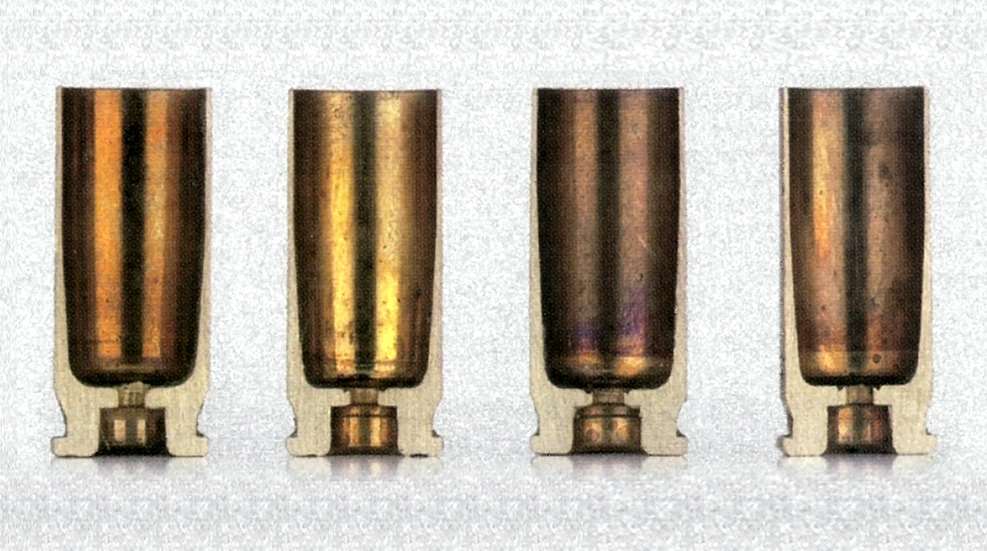
Above: A selection of .38 cartridges and derivatives (from left) .38 TJ, .38 Super Comp, 9 Super Comp and .38 Super+ P.
Nothing's perfect. John Browning's original .38 Auto cartridge design and its successor, the .38 Super, each had its faults. The Auto was a comparative weakling and the Super had accuracy problems that took five decades before a good headspacing method was developed.
The semi-rim was the troublemaker to be broached most recently. There is a nominal difference in the dimensions of the case diameter (0.383-inch) at the base and the rim (0.405-inch). This difference would account for a space 0.022-inch between two cases if the rims were touching.
This semi-rim caused a rift among the competitive shooting community and this cartridge. When the cartridges stacked in a straight-walled magazine, the spring pressure would cause the top cartridge to nosedive into the front rim of the magazine or the feed ramp, often resulting in a failure to feed. In a racegun, a failure to feed or even a hesitation in feeding can dash all hopes of winning a match. The .38 Super seemed to be more at home in a curved "banana-style" magazine rather than in a 1911 single-stack or double-stack. Another problem occurs if the second cartridge jumps a little forward in the magazine and the rim gets hung up on the cartridge below it. In feeding a lightly-sprung pistol, such as those used in Bianchi Cup and the Steel Challenge, a little hang-up becomes a big jam.
Back in the day when the cartridge headspaced on the rim, rim dimensions were critical. Since new firearms headspace on the mouth of the cartridge, the rim is only important for extraction.
The 9x23mm Winchester and later the 9 Super Comp from top brass manufacturer Starline were the first stops frustrated pistol shooters made. The 9 Super Comp was a truly rimless design with a straighter wall, thick web and neared 50,000 PSI operating pressure. While still in use, the 9 Super Comp shined brightly early on, but was quickly eclipsed by new innovations.
In the mid 1990s, National and World Champion IPSC shooter and well-known pistolsmith Matt McLearn introduced a rimless .38 Super brass in conjunction with Starline. The .38 Super Comp, as it was named, featured a rim diameter of 0.385-inch, a thicker web and a deeper extraction groove. Shooters flocked to the Super Comp because it maintains the same dimensions throughout the rest of the case. They found they could chamber the cartridge in their Super pistols with no or very little gunsmithing work, generally in the form of reshaping or replacing an extractor.
Another evolution was the .38 TJ designed by action shooting superman Todd Jarrett. Relatively similar to the .38 Super Comp, especially in its ability to be used in standard .38 Supers, the TJ attracted a small, yet dedicated fanbase. The extractor groove of the TJ is slightly deeper than that of the .38 Super Comp. Starline offers the brass for handloading.
Nothing's perfect. John Browning's original .38 Auto cartridge design and its successor, the .38 Super, each had its faults. The Auto was a comparative weakling and the Super had accuracy problems that took five decades before a good headspacing method was developed.
The semi-rim was the troublemaker to be broached most recently. There is a nominal difference in the dimensions of the case diameter (0.383-inch) at the base and the rim (0.405-inch). This difference would account for a space 0.022-inch between two cases if the rims were touching.
This semi-rim caused a rift among the competitive shooting community and this cartridge. When the cartridges stacked in a straight-walled magazine, the spring pressure would cause the top cartridge to nosedive into the front rim of the magazine or the feed ramp, often resulting in a failure to feed. In a racegun, a failure to feed or even a hesitation in feeding can dash all hopes of winning a match. The .38 Super seemed to be more at home in a curved "banana-style" magazine rather than in a 1911 single-stack or double-stack. Another problem occurs if the second cartridge jumps a little forward in the magazine and the rim gets hung up on the cartridge below it. In feeding a lightly-sprung pistol, such as those used in Bianchi Cup and the Steel Challenge, a little hang-up becomes a big jam.
Back in the day when the cartridge headspaced on the rim, rim dimensions were critical. Since new firearms headspace on the mouth of the cartridge, the rim is only important for extraction.
The 9x23mm Winchester and later the 9 Super Comp from top brass manufacturer Starline were the first stops frustrated pistol shooters made. The 9 Super Comp was a truly rimless design with a straighter wall, thick web and neared 50,000 PSI operating pressure. While still in use, the 9 Super Comp shined brightly early on, but was quickly eclipsed by new innovations.
In the mid 1990s, National and World Champion IPSC shooter and well-known pistolsmith Matt McLearn introduced a rimless .38 Super brass in conjunction with Starline. The .38 Super Comp, as it was named, featured a rim diameter of 0.385-inch, a thicker web and a deeper extraction groove. Shooters flocked to the Super Comp because it maintains the same dimensions throughout the rest of the case. They found they could chamber the cartridge in their Super pistols with no or very little gunsmithing work, generally in the form of reshaping or replacing an extractor.
Another evolution was the .38 TJ designed by action shooting superman Todd Jarrett. Relatively similar to the .38 Super Comp, especially in its ability to be used in standard .38 Supers, the TJ attracted a small, yet dedicated fanbase. The extractor groove of the TJ is slightly deeper than that of the .38 Super Comp. Starline offers the brass for handloading.
Most Popular