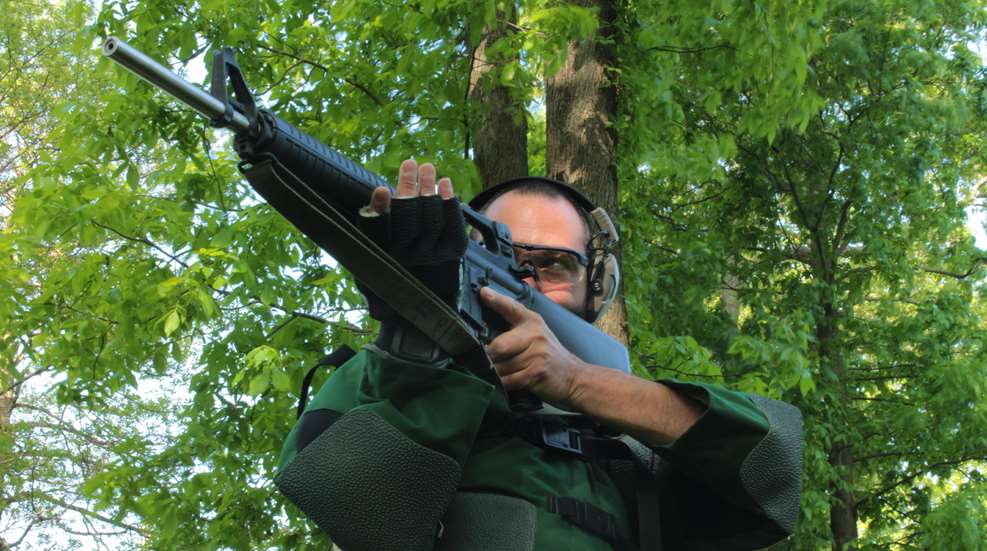
Offhand shooting is by far the hardest position to master in any rifle shooting sport. As most of us learned the fundamentals in the prone or benchrest position, sending a shot downrange while standing tall can be quite foreign the first time around. Nevertheless, if you want to excel in sports such as NRA High Power and Service Rifle, you have to get your sea legs and learn how to take the wobble out of your wobble area.
Here are five tips to get you started.
Dress for success.
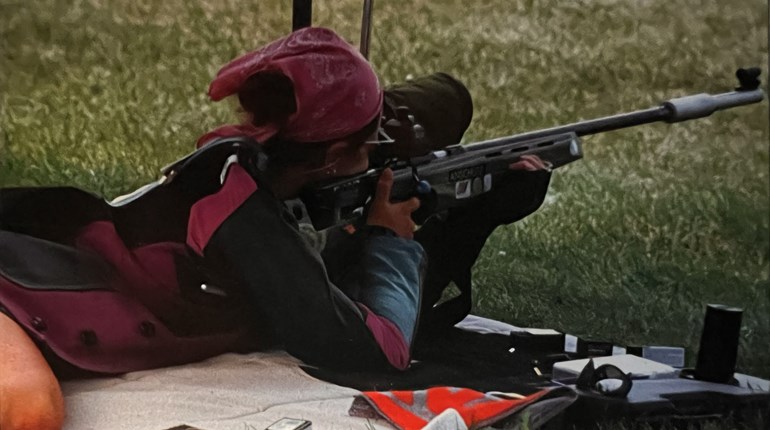
Top shooters will know the match rules and limitations. Among them are the rules regarding dress and stabilizing equipment. If your particular discipline allows for the use of a shooting coat, you are crazy not to invest. Is it cheating? Well, no more than using a 4.5X magnified optic or match-grade ammunition. The stiff material a shooting coat is made from, combined with the buckle system, provides invaluable lumbar support and reduces the amount of muscle used when holding your rifle. Most coats also have grippy material around the shoulder area to help keep the buttstock where you need it to be.
Already wearing a coat? Great, fill in the gaps and maximize your stability by wearing a sweatshirt or two (if allowed), which increases the garment’s efficiency and allows you to dial-in stability in one area without having to overtighten other areas to achieve it indirectly. If your discipline doesn’t permit shooting coats, learn what is allowed. Often, shirts made out of spandex are permitted that will also provide some support.
The shot isn’t over until the round hits the dirt.
This alludes to follow-through. If you’ve developed a habit of allowing your finger to fly off of the trigger, or your head to pop off of the stock as the gun fires, you need to break it yesterday. Shooting off of a bench covers up the effects of these actions, as the bipod or sandbag acts as a safety net and restricts the movement of the gun. However, when you are out on the island the gun is free to dip or elevate as it reacts to your movement. When the gun goes bang you should remain as still as possible (barring recoil) and keep the trigger pinned to the rear.
Go ahead and squeeze an imaginary trigger, you’ll notice that the rest of your fingers move as well. Not only do they move when you “press” that imaginary trigger, but when you release it as well. The other four fingers are tasked with an important job—keeping your sights on target. If they move when the gun is firing then the gun is moving a split-second before the bullet leaves the barrel. Keeping that trigger to the rear doesn’t allow that forward motion to take place and keeps the sights right where they were when you decided it was time to send a round.
Your first sight picture is your best sight picture.
For even the most basic courses at Renaissance Firearms Instruction, this concept is presented across the first hour of marksmanship training. During a demonstration, I hold a rifle completely outstretched and then ask students if it is getting steadier or wobblier. Even those that have never held a firearm before understand that it is getting less steady as time goes on. Next, I bring it closer and ask the same question, and normally get the same answer. Finally, I assume a traditional offhand shooting position and ask the question again. The truth is that once a muscle is engaged it starts to expire immediately.
After building your shooting position and exhaling your final breath you should strongly consider pressing the trigger the first time your sights cross the X-ring. Being able to steady the rifle by “trying really hard” is a complete fallacy, as we are asking more from our muscles as they continue to become less effective.
Build your natural point of aim.
If your goal is to get the shot off as soon as possible, then it helps if the sights come onto target the first time around. Positioning your body to help you do so is called building your natural point of aim. The nuances behind getting this perfect are nearly infinite, but it starts with aligning your upper body and your rifle with the target. Typically, your feet will be completely perpendicular to your target and your hip should be slightly forward as well. Once you feel that you have a good alignment, test it by closing both eyes, relaxing completely and then reopening them. If you are still on target, that is great. If not, rotate your feet to correct your windage or adjust your stance to correct elevation. Getting this just right not only puts you on target faster, but it ensures that you are doing so with as little muscle as possible.
Practice, practice, practice.
While cliché, the need to practice is true here. Simple dry-fire practice will condition the required muscles and reduce altogether the amount of muscle power used. In other words, you don’t even need to get to the range to get better at shooting from your feet. I’m a left-handed shooter. However, when instructing or posing for a photo, I often do so right-handedly, so the majority of my students and readers don’t have to think as much about how to apply the demonstrated method to their own shooting. After doing this for more than a decade, I am nearly as capable on my weak side as I am on my strong side.
Read more: Budget Service Rifle Build